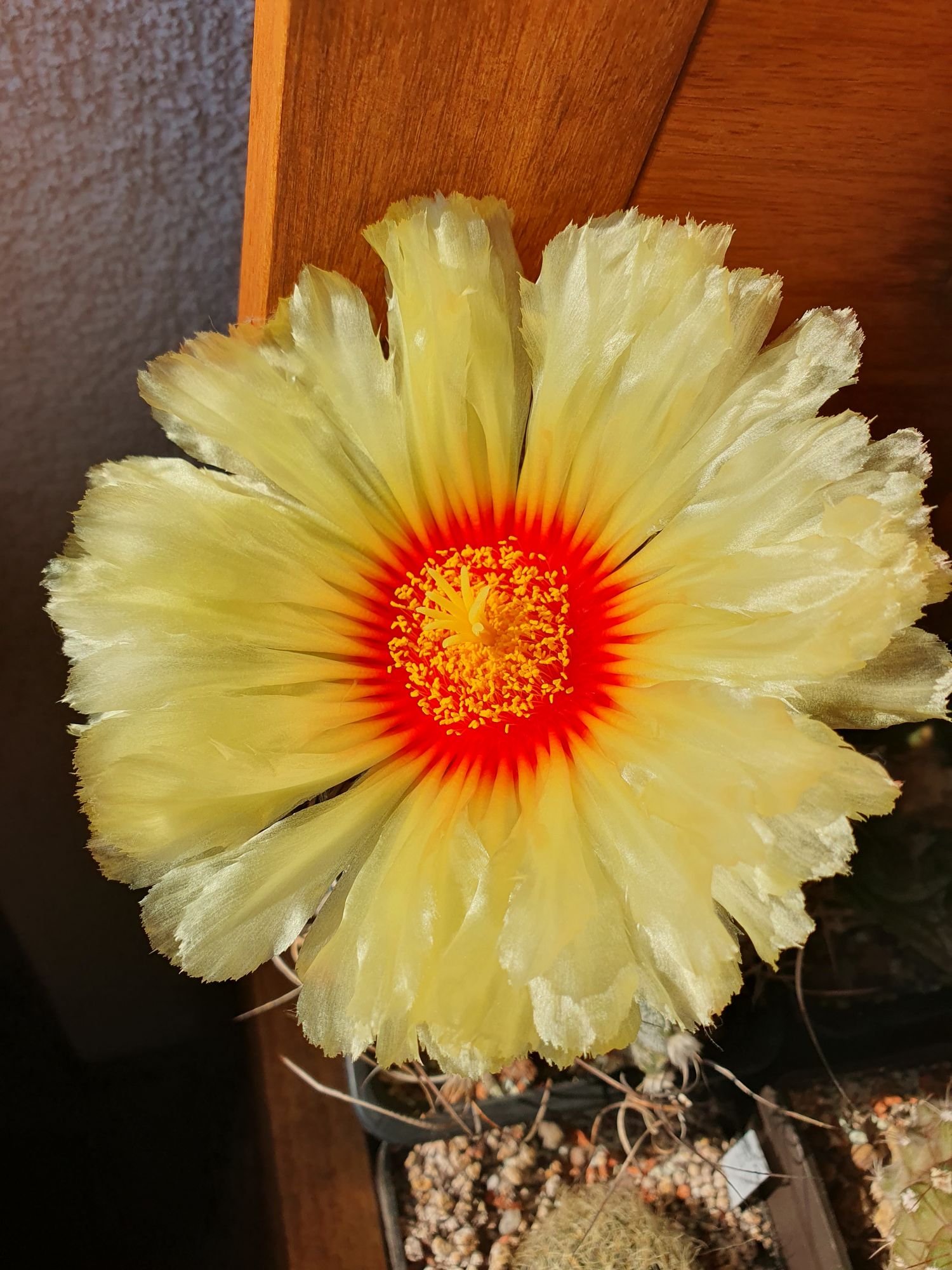
A wide pale yellow Astrophytum flower with a red centre, open above the plant on a balcony shelf.

Indoor collection

The room after dark.

Cacti and a few succulents beside one window. Our own photographs, and notes for the person who waters them.

Enter the collection
The 29 01 — 29
Cacti
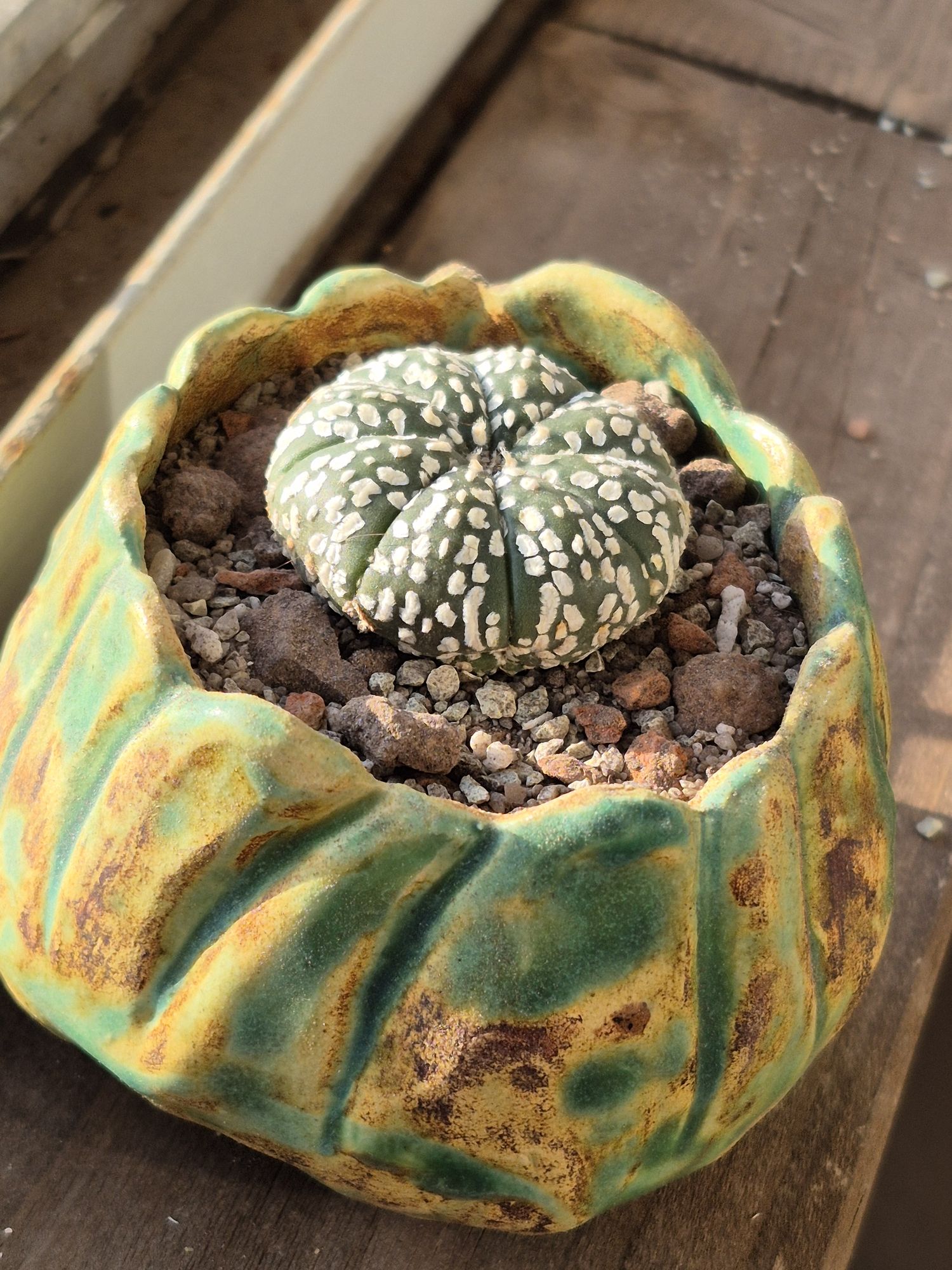
A small flat sea urchin cactus with eight ribs speckled in white wool, in a green glazed pot on a wooden sill.

01 · Flat

Sea urchin

Astrophytum asterias

No spines at all. Eight soft ribs and tiny tufts of white wool, like a sand dollar. At home on the Texas–Mexico border it sits almost level with the soil and is easy to miss until it flowers: yellow, with a red centre. Bone dry and cool all winter.
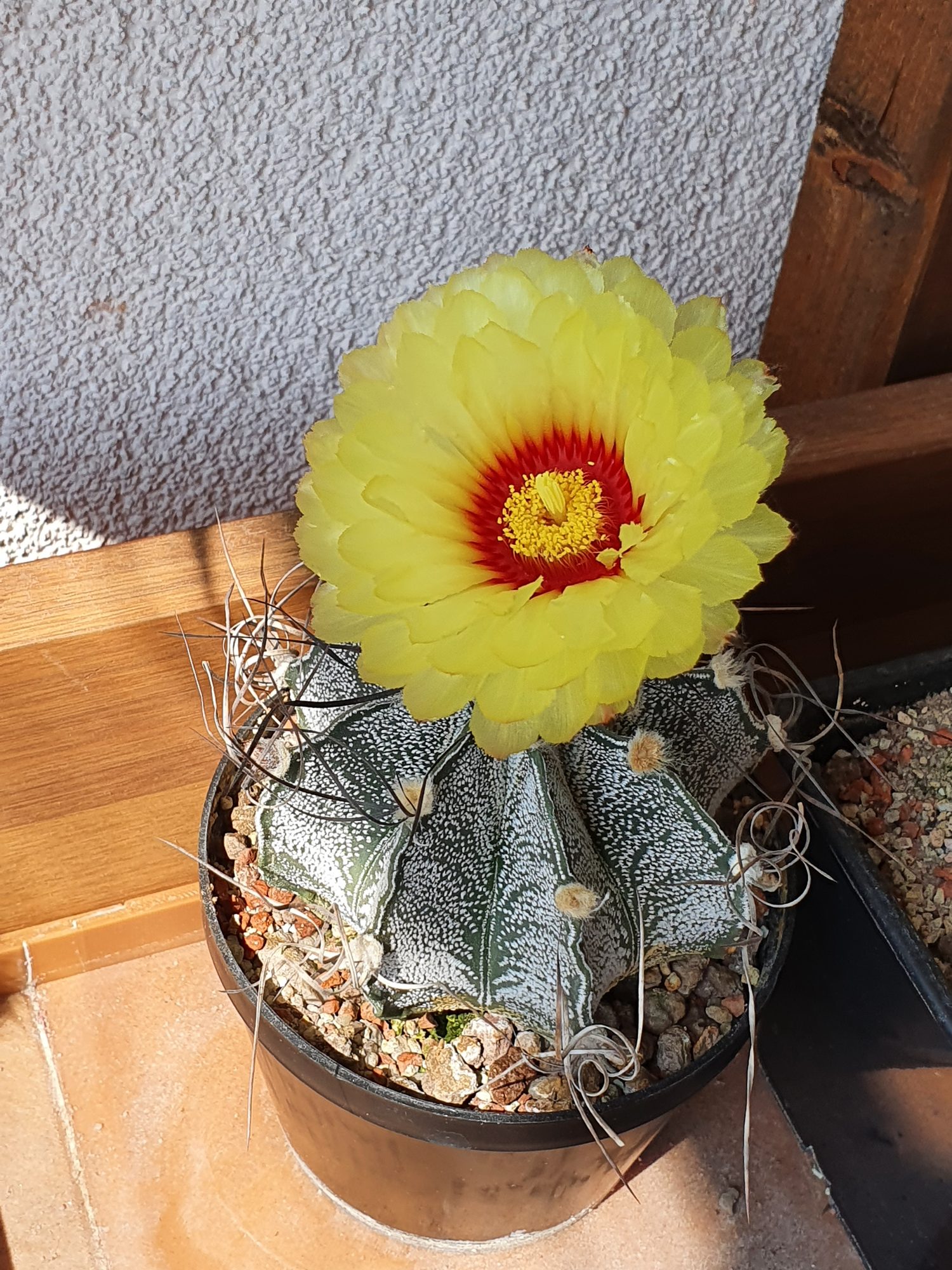
A grey Astrophytum capricorne flecked with white, wrapped in long twisted spines, under one big yellow flower with a red centre.

02 · Horned

Goat’s horn

Astrophytum capricorne

A cousin of the sea urchin, but wrapped in long, flat, twisting spines that curl like a goat’s horns. Under them the ribbed grey body is dusted with white flecks. It comes from dry hills in Coahuila, northern Mexico. In summer it opens a wide, silky yellow flower with a red heart. Full sun, a mineral mix, and no water at all over a cool winter.
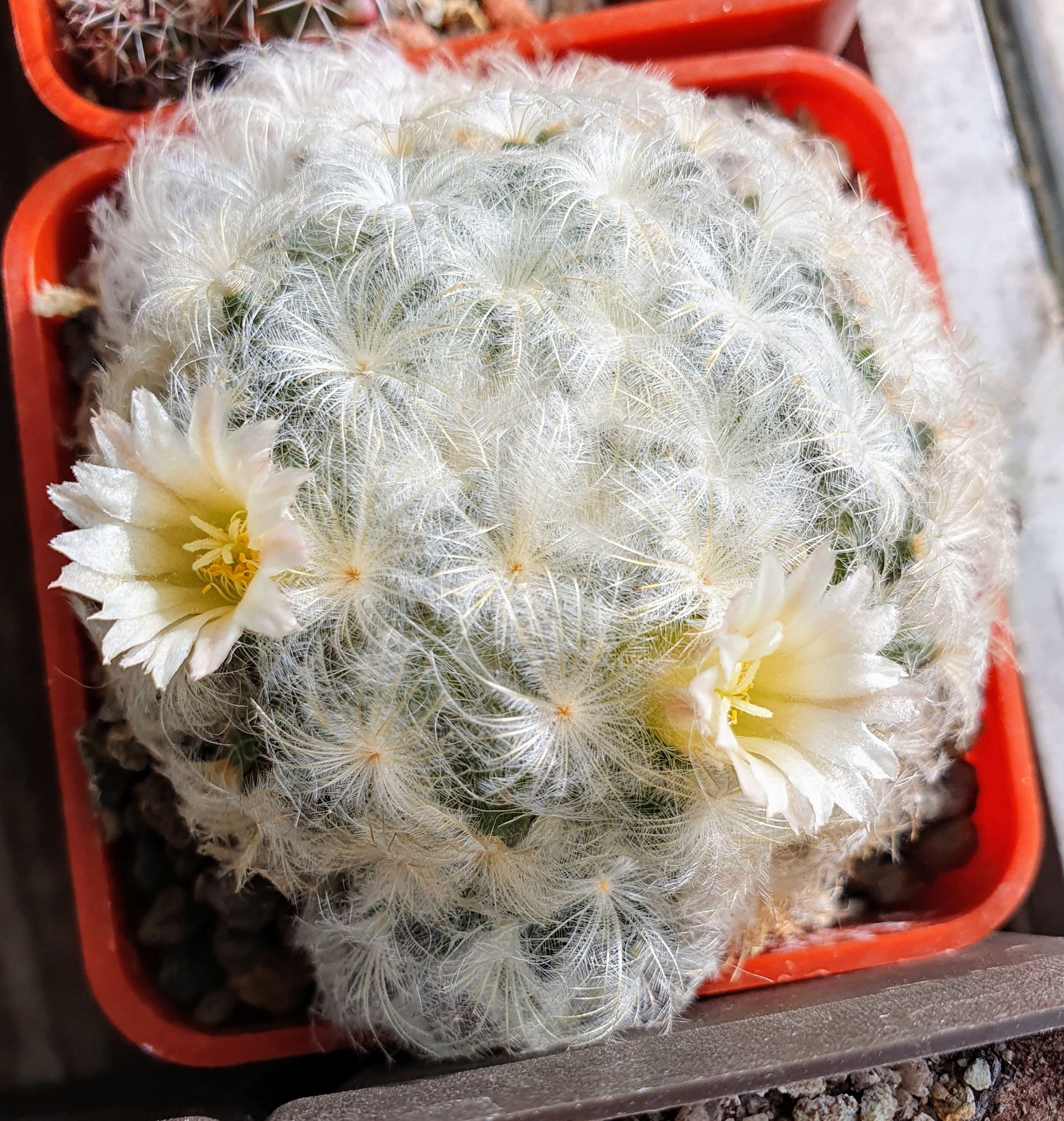
A mound of feather cactus heads covered in soft white spines, with two cream flowers open.

03 · Clustering

Feather cactus

Mammillaria plumosa

Every white feather is a spine, about forty to a cluster, so the green body hardly shows. It comes from limestone cliffs in northern Mexico. The small cream flowers smell sweet. Water the soil, never the feathers, because this one rots easily.

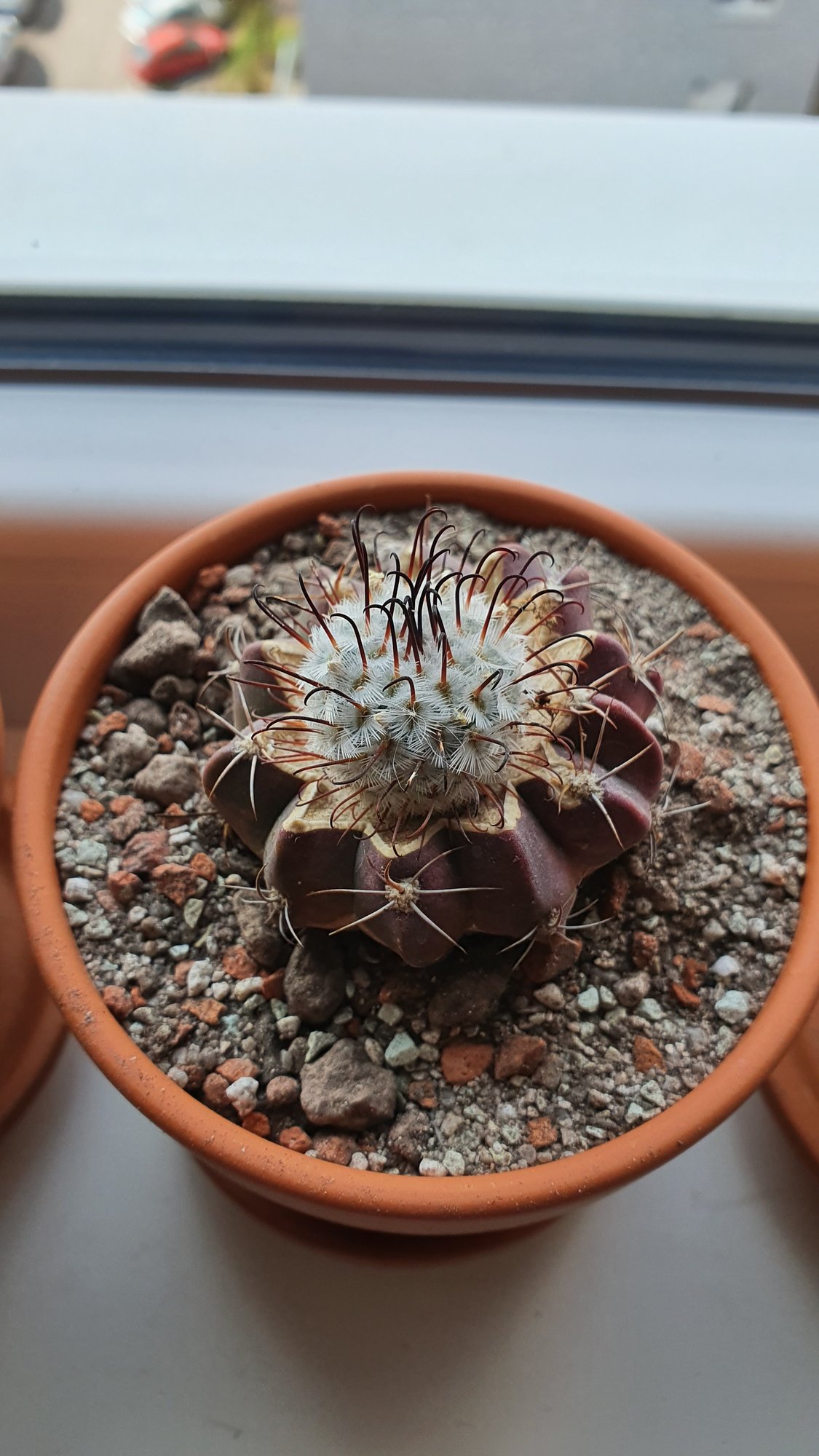
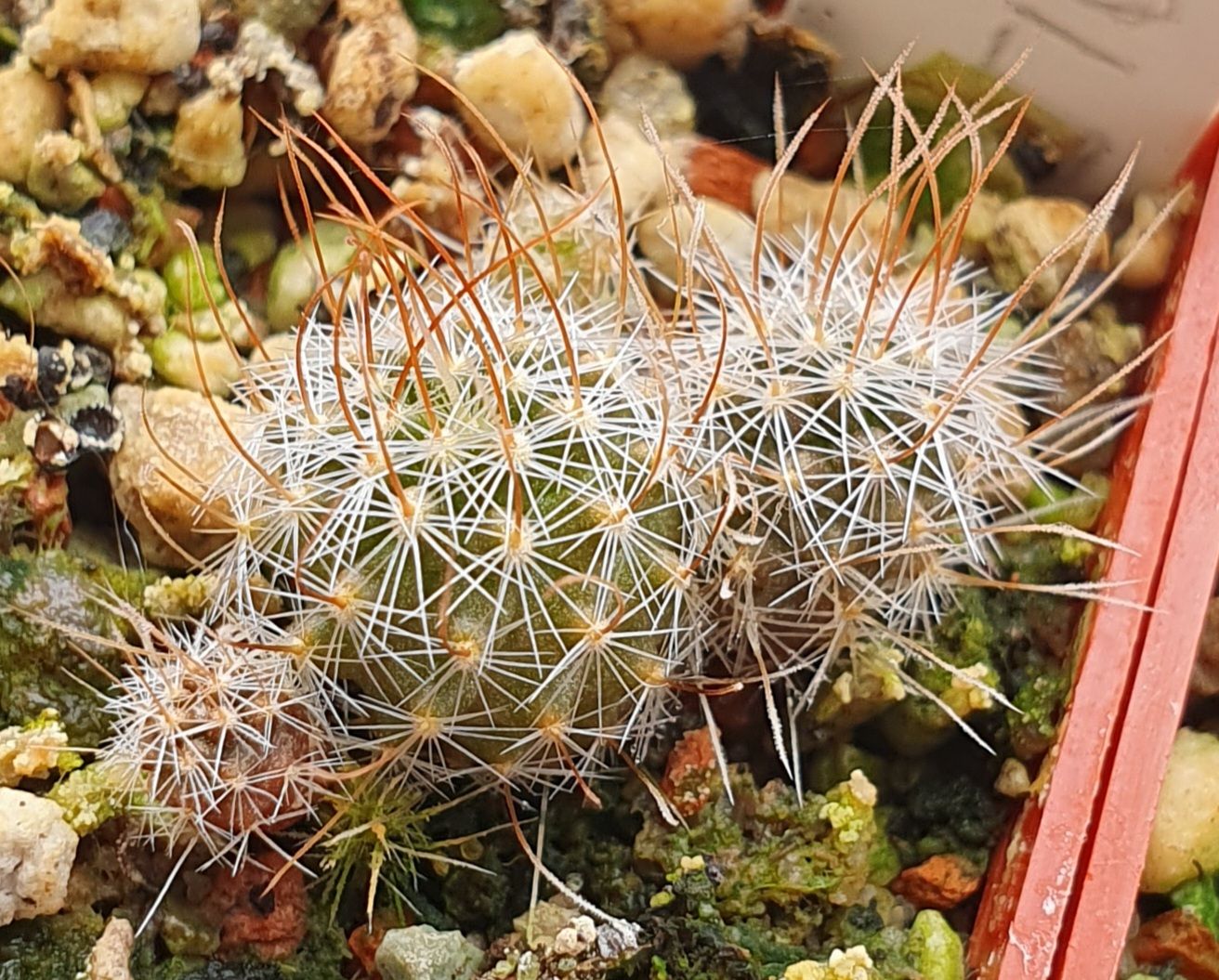
A small Mammillaria perezdelarosae head of white lacy spines and dark hooked centrals, grafted on a dark purple ribbed stock, in a terracotta pot on a window sill.

04 · Hooked

Fishhook pincushion

Mammillaria perezdelarosae

A tight little head of white, lacy radial spines, and poking out of them a crown of long, dark, hooked centrals that catch on everything. It comes from steep rocky slopes high in the mountains of Jalisco, Mexico. Ours sits grafted on a dark purple stock, which pushes it along faster than its own roots would. Pale pink-and-white flowers can ring the head in late winter. Bright light, sparse water and a cool, dry winter.
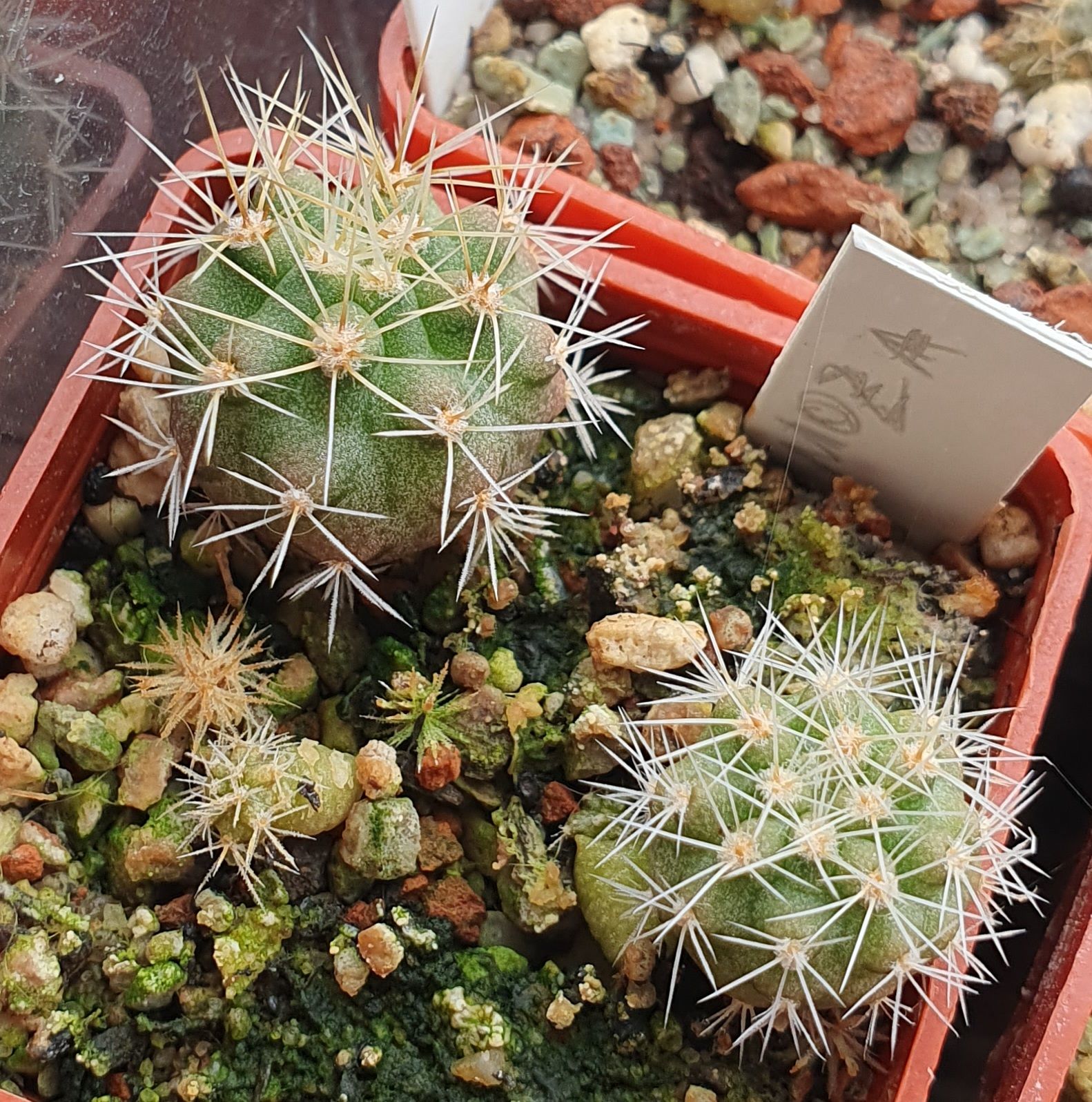
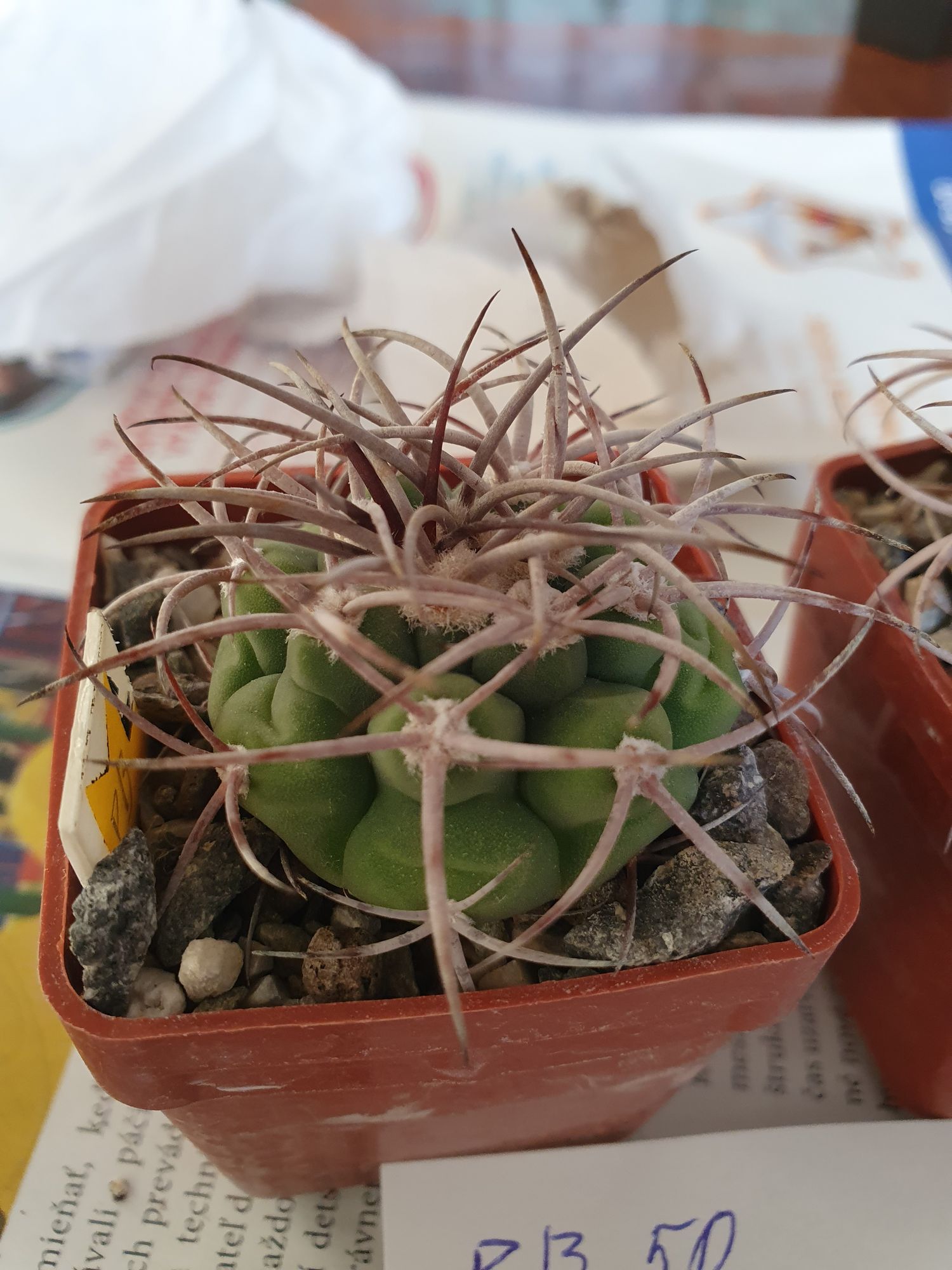
A green Gymnocalycium castellanosii with long pale curving spines, in a terracotta pot on newspaper.

05 · Solitary

Chin cactus

Gymnocalycium castellanosii

A green ball with stout, pale spines that bend back over the body. Wild plants grow on rocky slopes in western Argentina, where summer days pass 40 °C. The flowers are white with a pink throat. Ours came with a handwritten note: PB 50, Tama, La Rioja, sown in 2011.

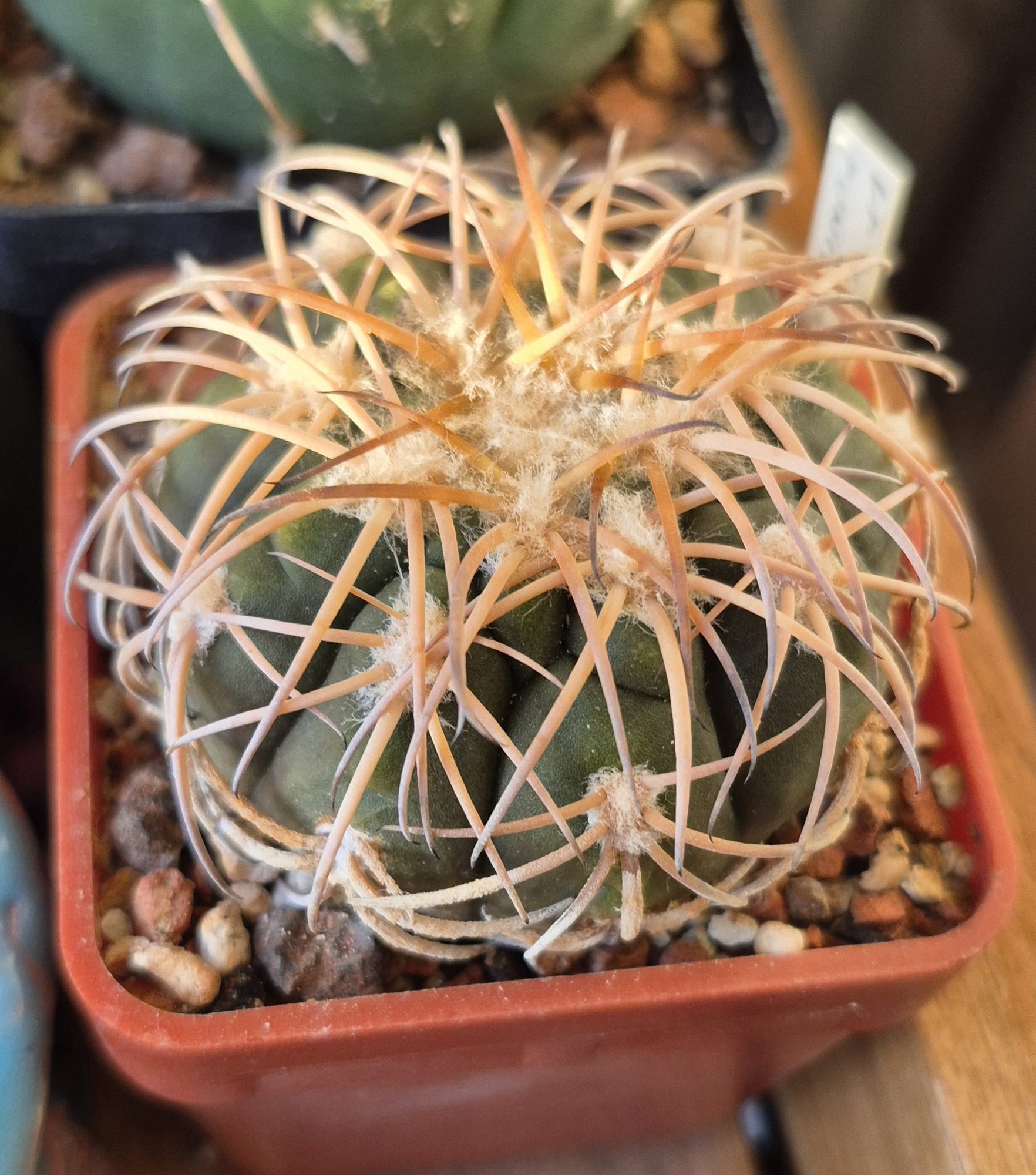
A Gymnocalycium spegazzinii var. punillense almost hidden under long pale, curving spines that bend over its grey-green body, in a square terracotta pot.

06 · Clawed

Spegazzini’s chin cactus

Gymnocalycium spegazzinii var. punillense

A flat grey-green body under a cage of long, pale spines that curve back and grip the plant like claws. This form comes from the dry valley of the Río Las Conchas in Salta, northern Argentina. Pale pinkish-white flowers open in spring. It grows slowly and likes plenty of sun, a lean mineral mix, and a completely dry winter.
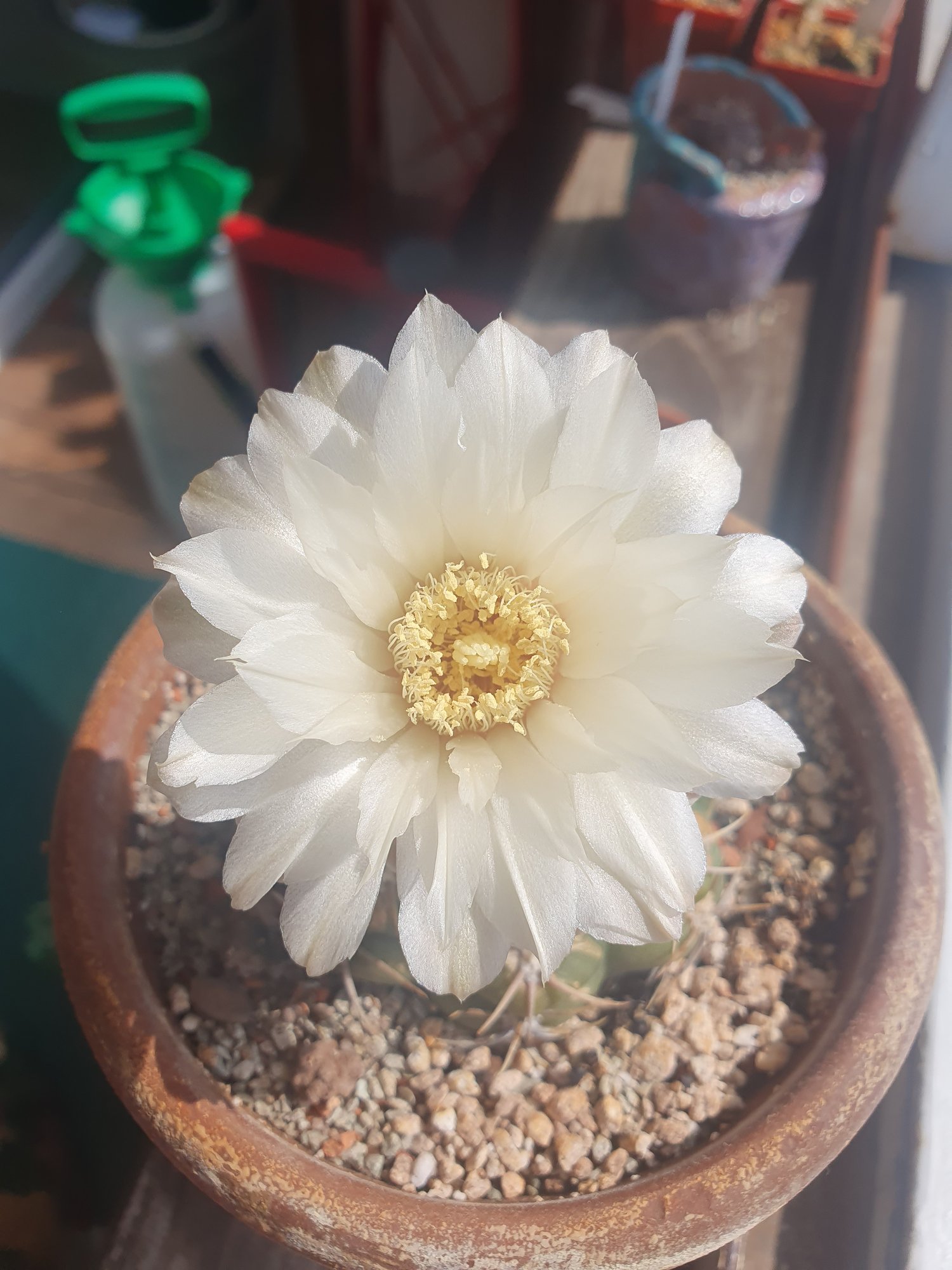
A Gymnocalycium megalothelon almost hidden under one large white flower with a cream-yellow centre, in a round brown clay pot.

07 · Snow-white

Big-nippled chin cactus

Gymnocalycium megalothelon

A flat, dark green globe with a few broad ribs broken into big rounded humps; megalothelon means large nipples. It comes from San Luis in Argentina, and many growers treat it as a local form of G. denudatum. In late spring it covers itself with wide, satiny white flowers, often with a second row of petals, and it sets seed even on its own. Like other chin cacti it is happy with a little shade in high summer.

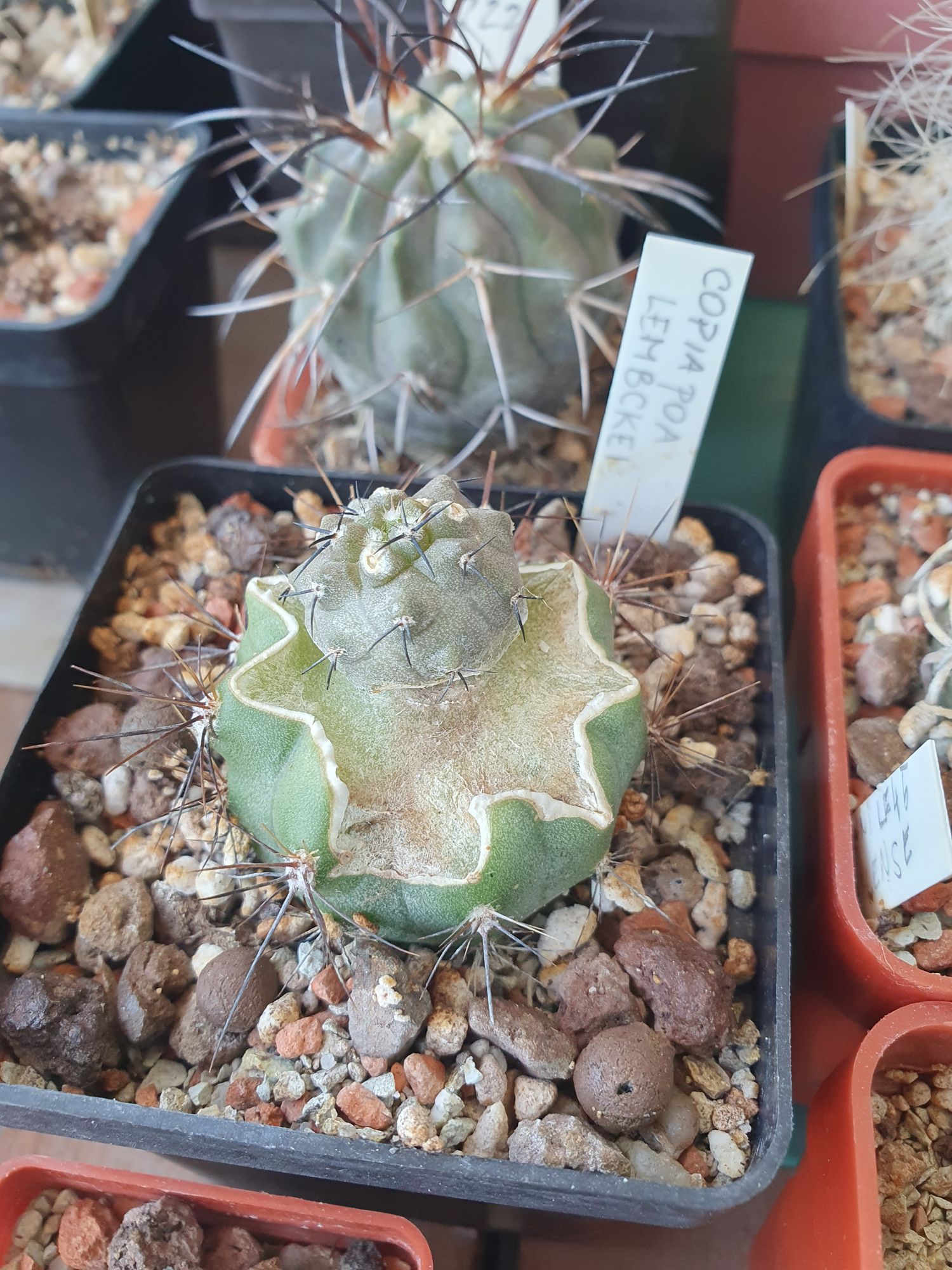
A small grey-green Copiapoa lembckei grafted onto a green rootstock, in a black pot with its name label.

08 · Coastal

Copiapoa

Copiapoa lembckei

From the Chilean coast around Caldera, one of the driest places on earth. Rain hardly comes, so it drinks the sea fog. Pale yellow flowers open from a woolly crown. The name on our label is an older one: botanists now count it as Copiapoa calderana. Ours is grafted: the grey head on top is the Copiapoa, riding on a green rootstock. Bright light, careful water, a dry winter at about 10 °C.

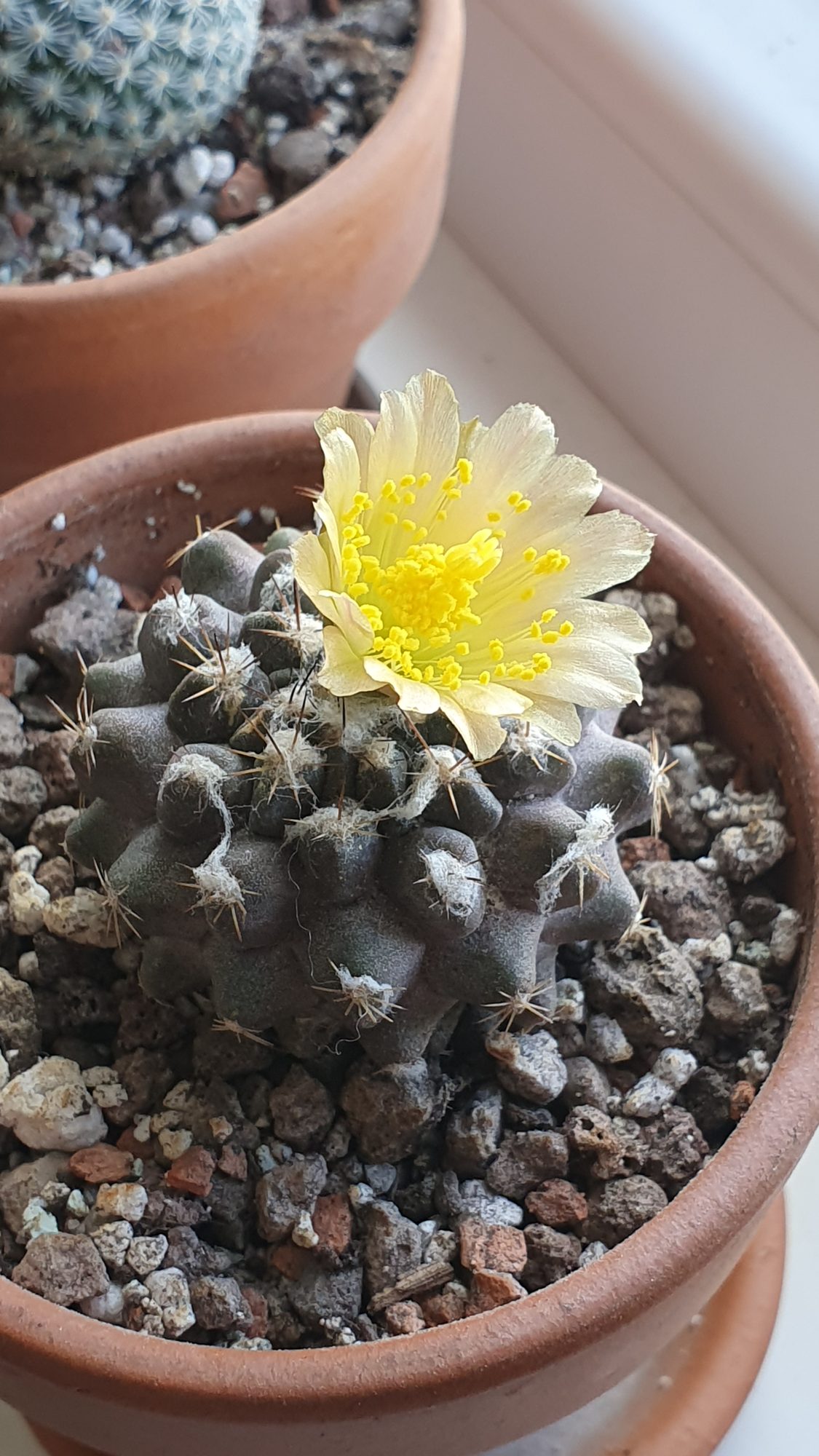
A small dark grey-brown Copiapoa humilis with knobbly tubercles and short spines, a pale yellow flower open on top, in a terracotta pot.

09 · Low

Humble copiapoa

Copiapoa humilis

Humilis means low, and it stays small: a dark, knobbly head that offsets slowly into a little clump over a thick taproot. It grows on the foggy coast of northern Chile, where it lives on mist more than rain. Unlike many of its bigger relatives, it flowers young, with soft pale yellow blooms on and off through summer. Very gritty soil, and water only when the pot is fully dry.

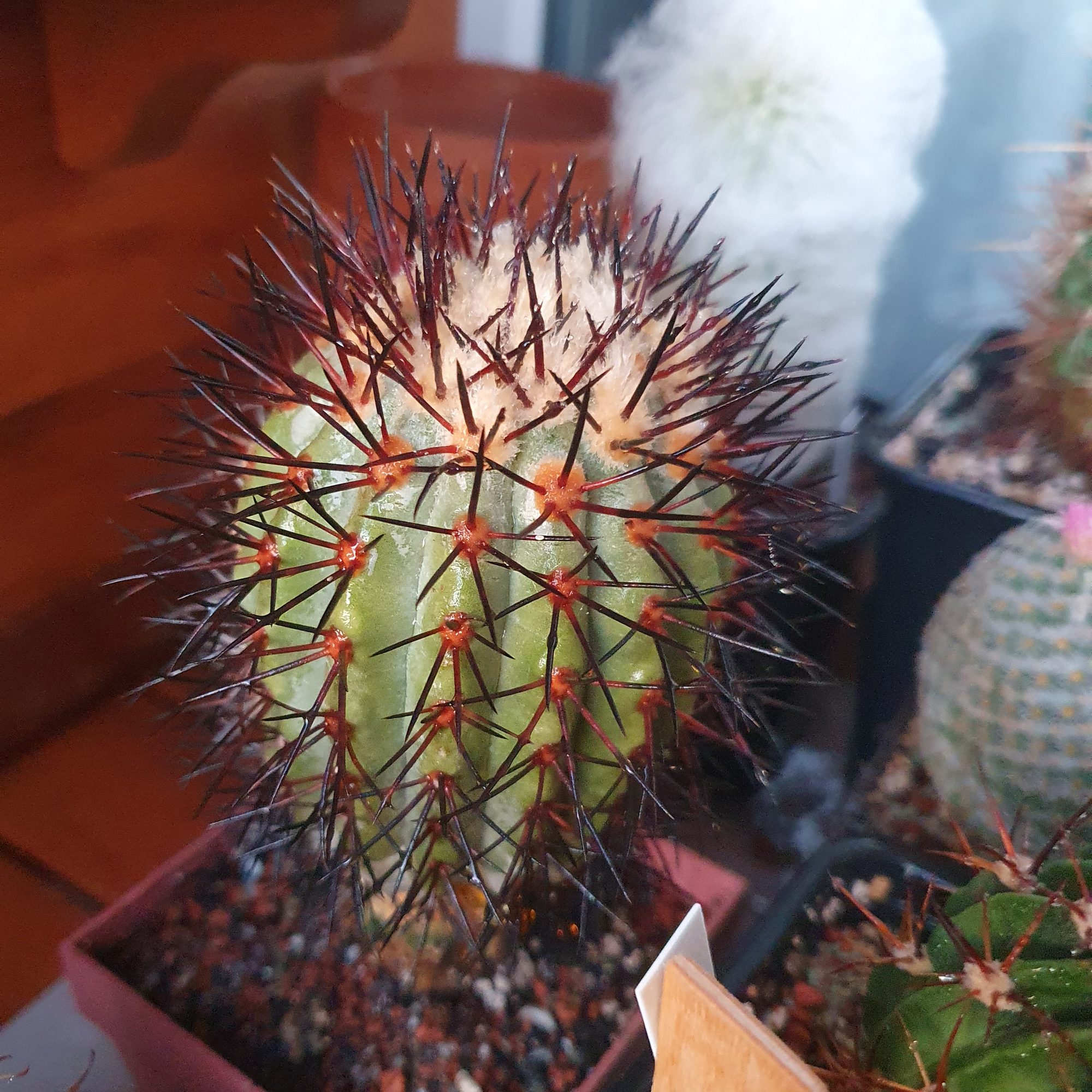
A young Copiapoa cinerea, a green ribbed column with a cap of cream wool and long black spines, among other pots on a shelf.

10 · Ash-grey

Ash copiapoa

Copiapoa cinerea

In the Atacama desert of Chile this one turns chalk-white: a waxy coat on the skin keeps out the sun and the dry wind, and against it the black spines look almost painted on. That white only comes with age and very strong light, so young plants in a pot stay green, like ours. It is slow and can live a very long time. Very little water, a mineral mix, and a dry winter around 10 °C.

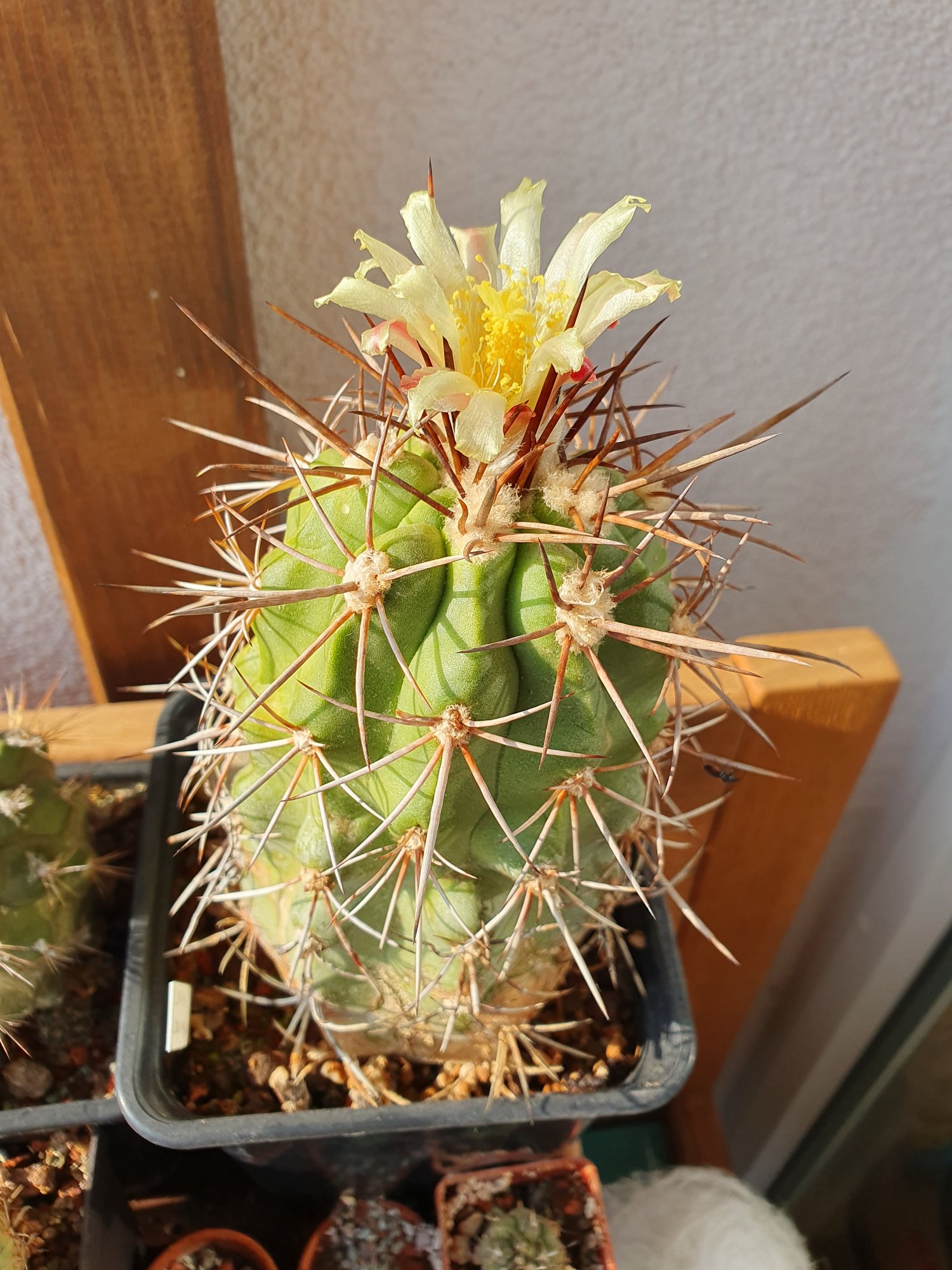
A green, ribbed Copiapoa coquimbana head with pale and dark spines and a cream-yellow flower at the top, against a white wall.

11 · Coastal

Coquimbo copiapoa

Copiapoa coquimbana

Named after Coquimbo, the stretch of Chilean coast where it grows among rocks within reach of the sea fog. In the wild it builds big mounds of dozens of heads; in a pot it starts as a single green, ribbed body with stiff pale and dark spines. Its flowers are pale lemon to cream and open from the woolly crown in summer. It is one of the easier copiapoas: sun, a gritty mix, and a dry, bright winter.
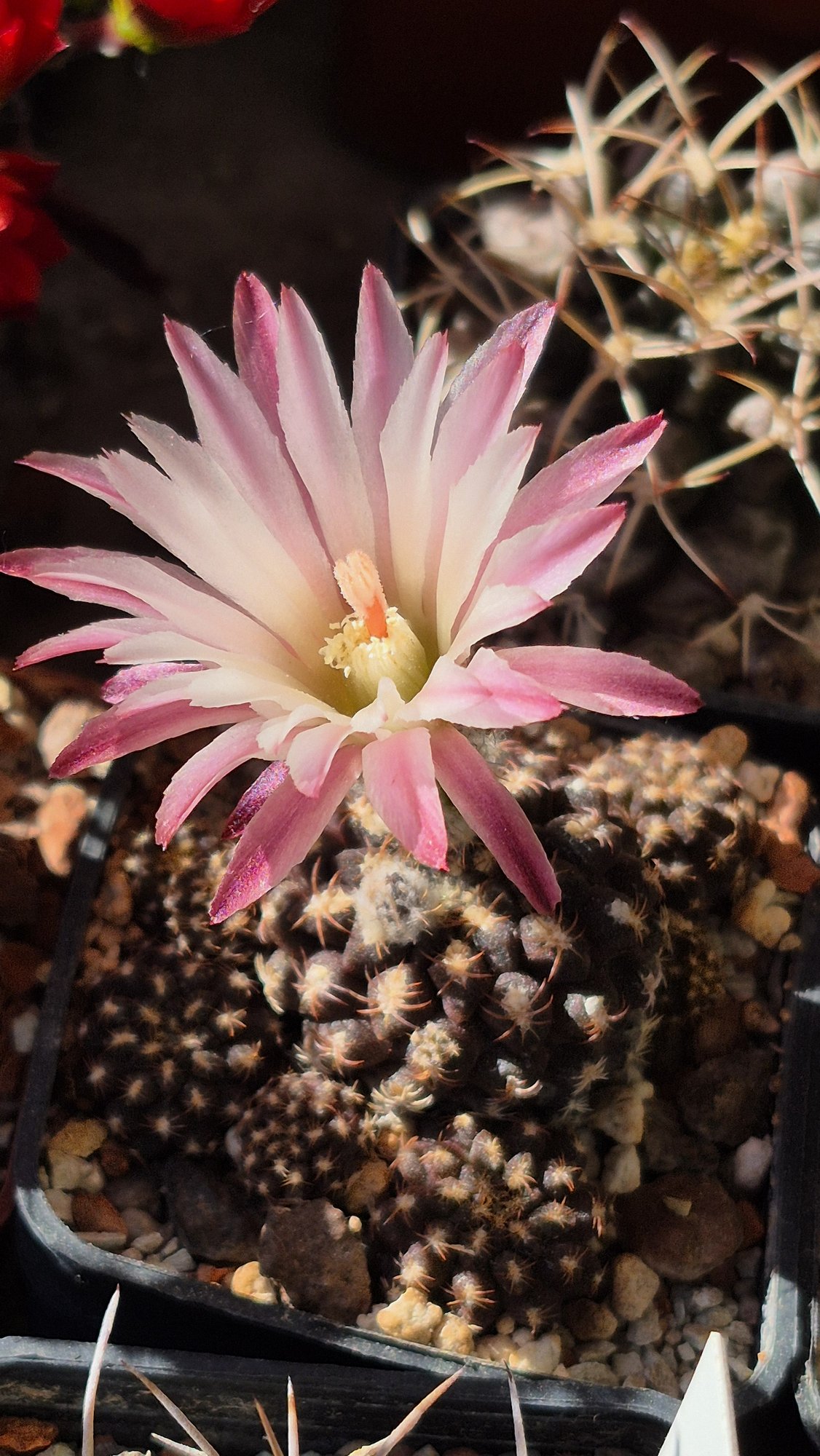
A tiny dark brown Eriosyce esmeraldana covered in round tubercles, under a big pale pink flower with darker stripes.

12 · Dwarf

Esmeralda

Eriosyce esmeraldana

A dwarf from near Esmeralda in the Antofagasta region of Chile, one of the driest places on earth. It is little more than a dark brown button of warty tubercles on a thick taproot, with a few short spines. Growers long kept it in its own genus, Thelocephala; now it is an Eriosyce. The flower is a surprise: wide, silky and pink, much bigger than the plant. It rots easily, so water sparingly, give it a deep pot for the root, and keep it fully dry in winter.
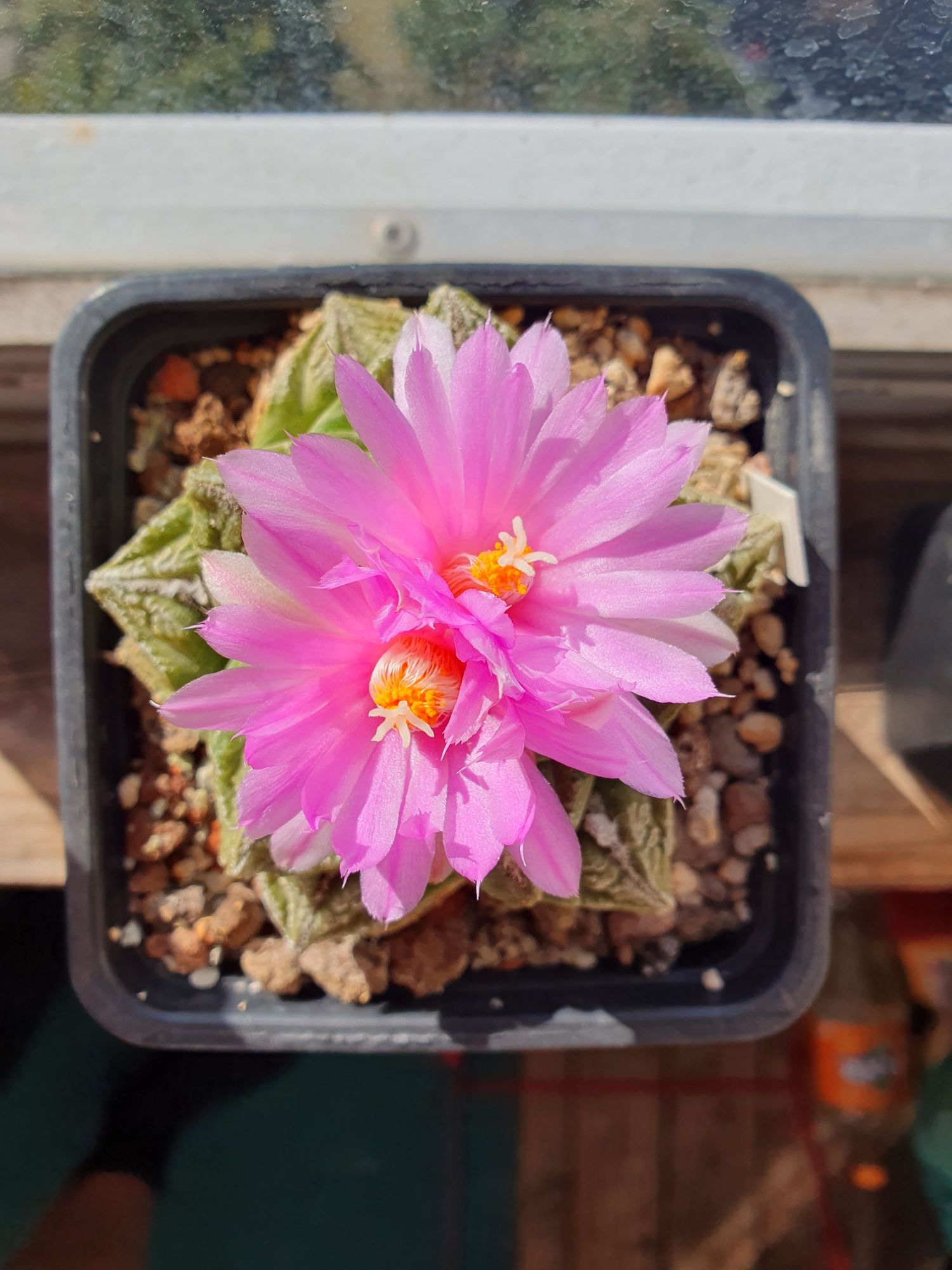
A flat Ariocarpus fissuratus with cracked, triangular tubercles, almost hidden under two wide pink flowers, seen from above in a black pot.

13 · Living rock

Living rock

Ariocarpus fissuratus

Hardly a cactus to look at: a flat star of cracked, wrinkled grey-green tubercles that barely rises above the stones. It comes from the Chihuahuan Desert in west Texas and northern Mexico, and grows very slowly. Then in autumn comes a pink flower almost as wide as the plant. Ours flowered in October, right on time. Full sun, a purely mineral mix, and no water in winter.
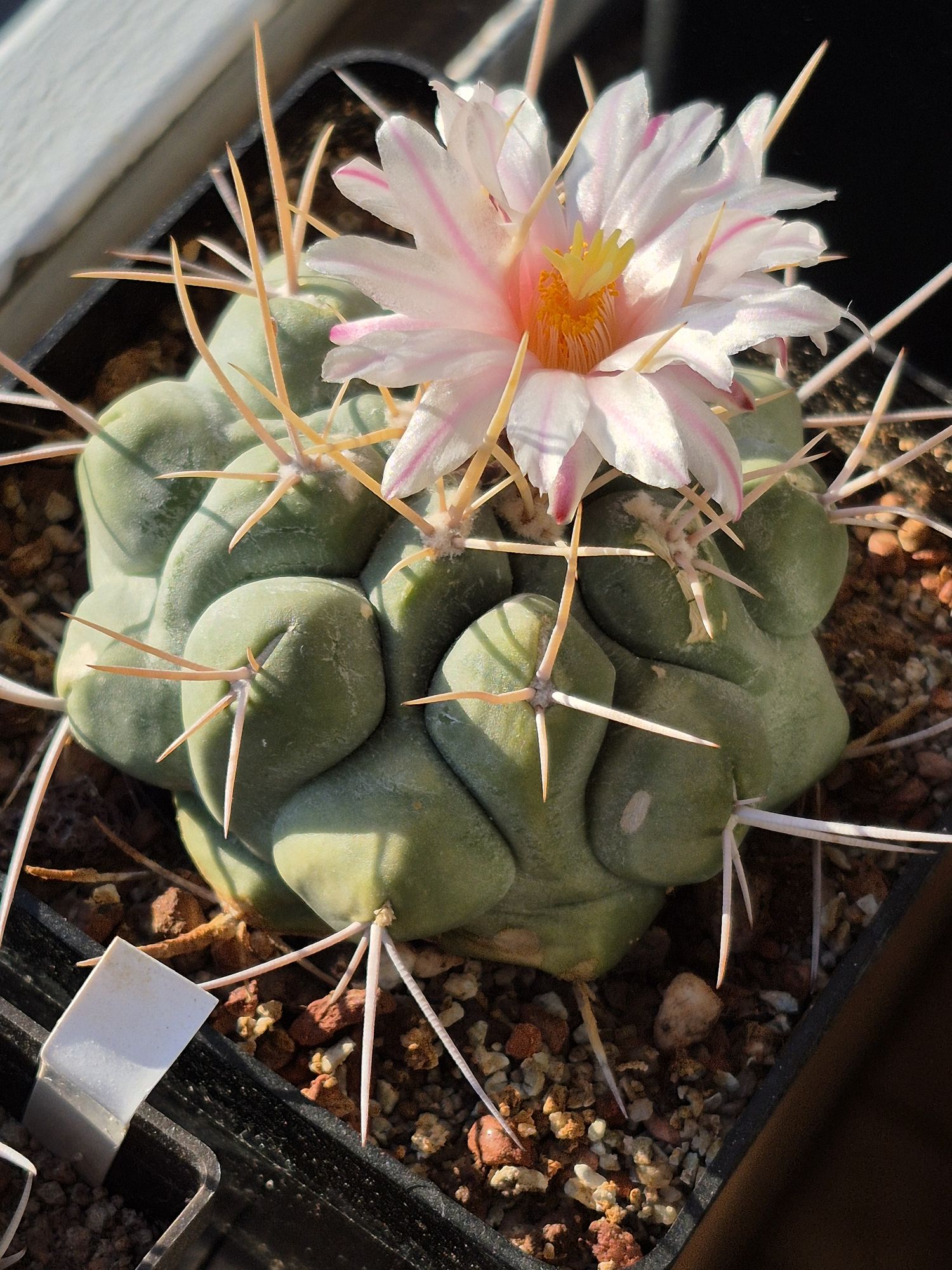
A blue-grey Thelocactus hexaedrophorus built of rounded six-sided tubercles with stiff pale spines, a white and pink striped flower open on top.

14 · Tubercled

Thelocactus

Thelocactus hexaedrophorus

The name means “carrying hexagons”: the blue-grey body is built of six-sided bumps, each with a star of stiff, pale spines. It lives on limestone hills in northeast Mexico, up to 2,300 m. Silvery-white flowers with pink stripes open in spring. Give it gritty soil, and let the thick root dry out before the next watering.

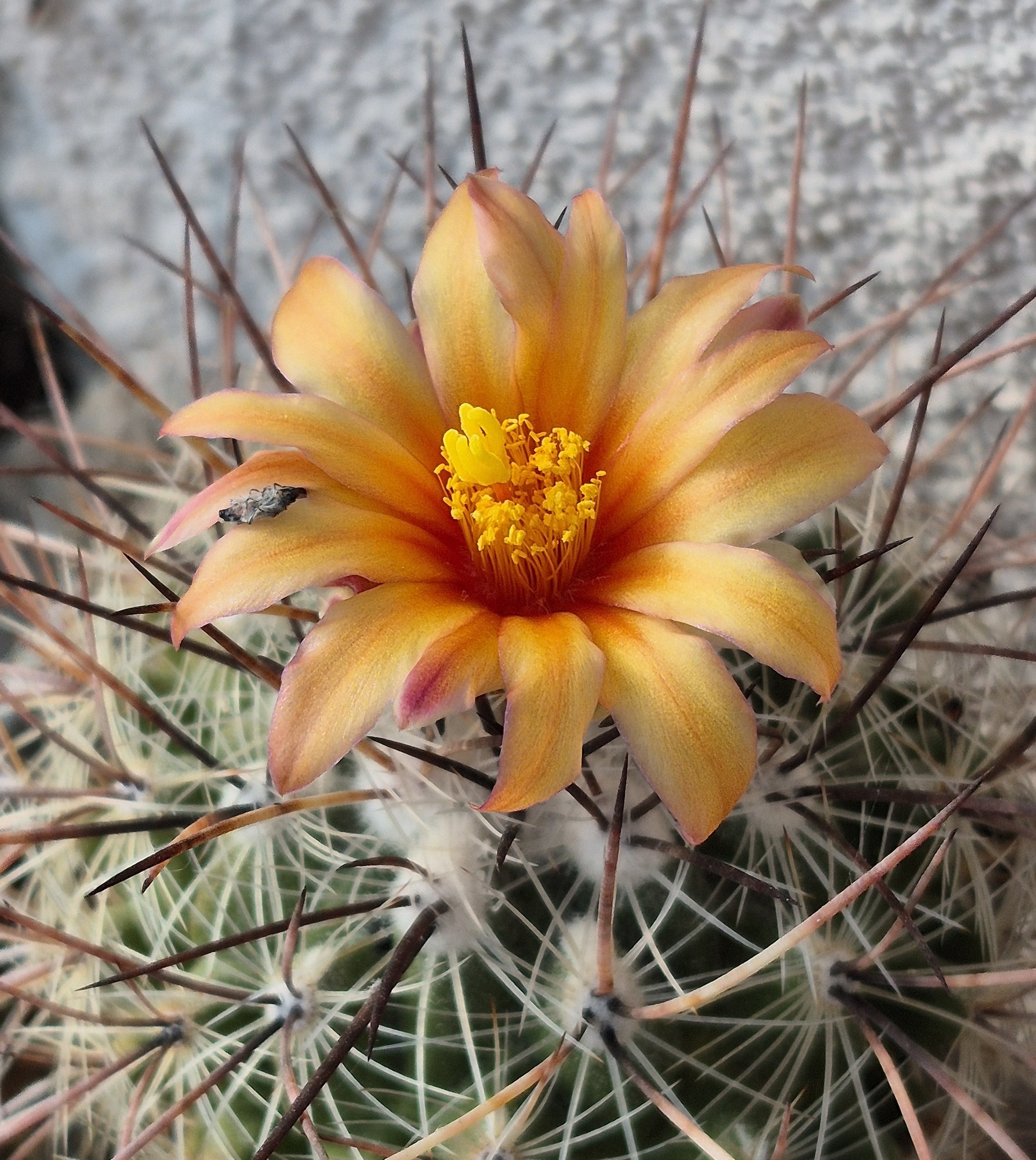
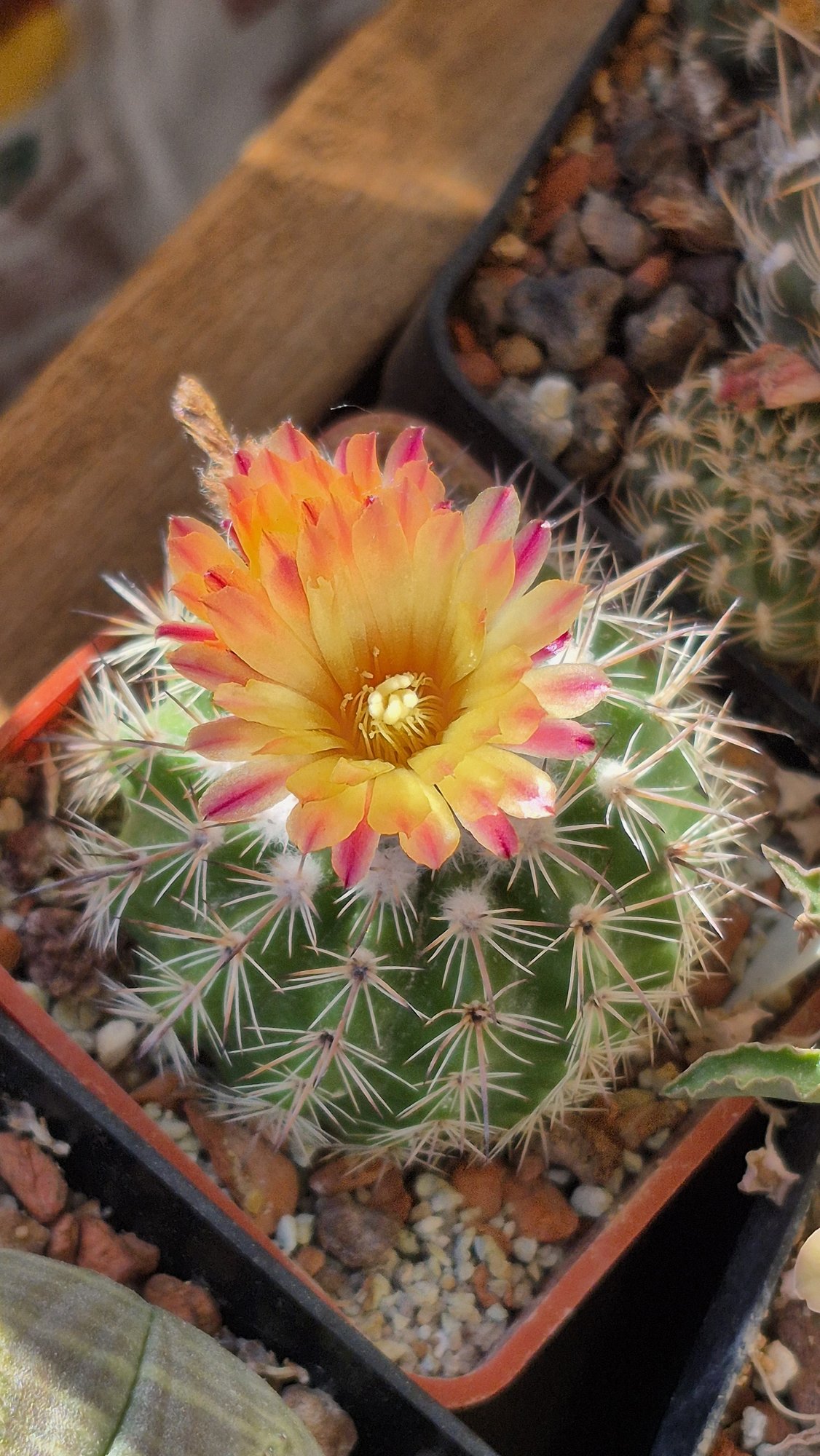
A Thelocactus conothelos subsp. aurantiacus covered in glassy white and brown spines, with a large orange-yellow flower open at the top.

15 · Orange-flowered

Orange thelocactus

Thelocactus conothelos subsp. aurantiacus

Most thelocactus flower pink or purple; this one, from Nuevo León in north-east Mexico, opens bright orange-yellow, which is where aurantiacus comes from. The body is a green globe of cone-shaped tubercles, almost hidden under glassy white radial spines and a few longer brownish centrals. It flowers in spring, sometimes twice. Full sun, water through the warm months, and dry in winter; it shrugs off a light frost.

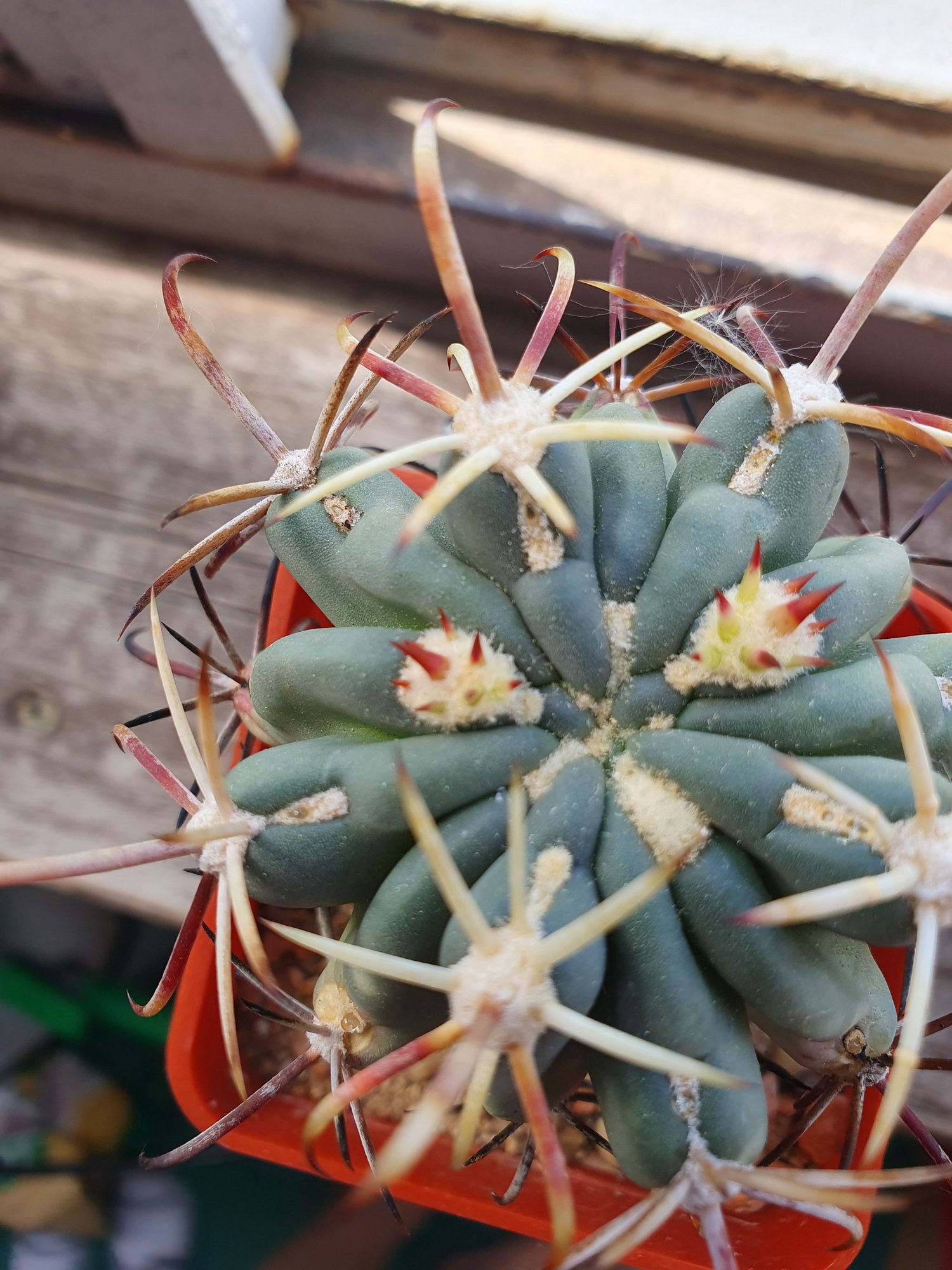
A blue-green Glandulicactus uncinatus with stout ribs, seen from above, its areoles carrying long pale hooked spines and red-tipped buds.

16 · Hooked

Chihuahuan fishhook

Glandulicactus uncinatus

A blue-grey body with thick ribs and long, flat spines, the main one hooked at the tip like a fishing hook, which is what uncinatus means. The areoles also carry small nectar glands, which gave the genus its name. It grows in the Chihuahuan desert, from Texas and New Mexico down into Mexico, often hidden in clumps of grass. The flowers are an unusual dark brownish red, in early spring. Lots of sun, careful watering, and a cold, dry winter.
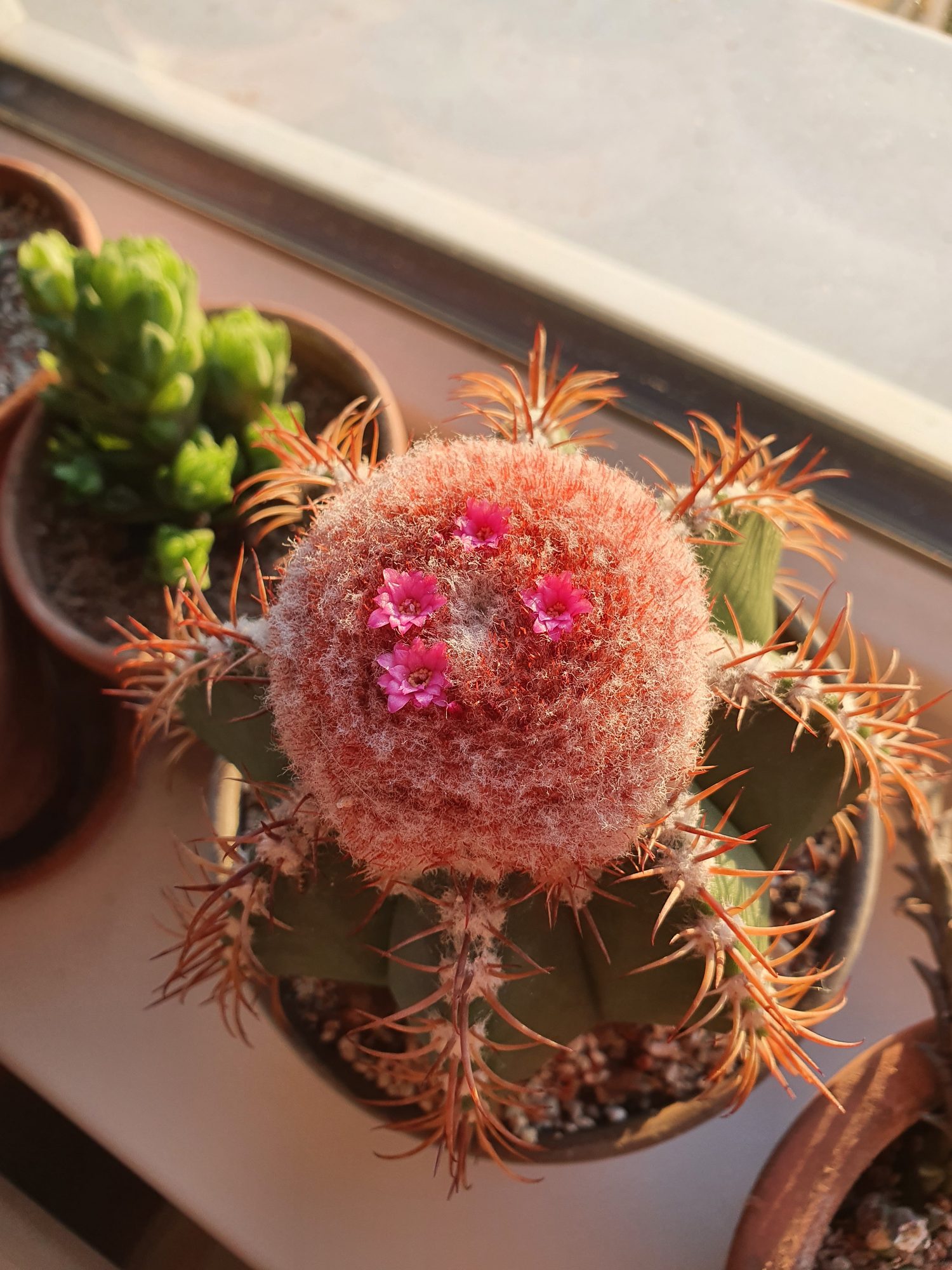
A small green Melocactus matanzanus topped with a round woolly cap of orange-red bristles, small pink flowers poking out of it.
17 · Capped

Turk’s cap

Melocactus matanzanus

Once it is grown up, only the top keeps growing. The green body stops getting bigger and a felty cap of orange-red bristles, the cephalium, rises on top. All the flowers and fruits come out of it: small pink flowers, then little pink fruits. It is from Matanzas in northern Cuba, and one of the smallest of its kind. It hates the cold: keep it warm in winter, never below about 12 °C.

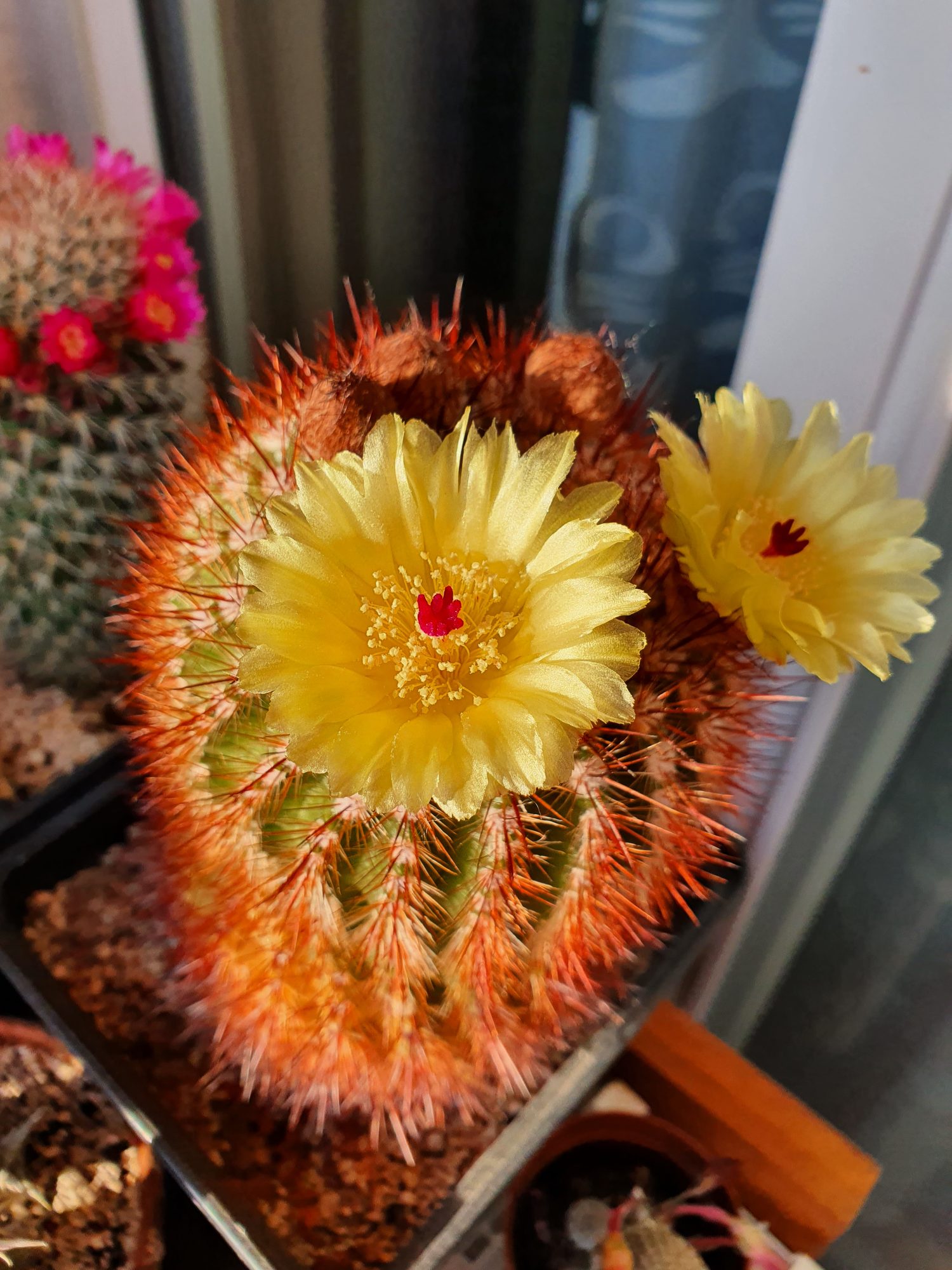
A round Notocactus floricomus var. rubrispinus glowing with dense orange-red spines, two large lemon-yellow flowers with red centres open on top.

18 · Red-spined

Red-spined notocactus

Notocactus floricomus var. rubrispinus

A green ball so densely spined it glows orange-red in the light, which is what rubrispinus says. The species comes from the grassy hills of Uruguay. In early summer it opens big lemon-yellow flowers with a dark red stigma, often several at once, and again a few weeks later. Botanists now file it under Parodia, but growers still call it Notocactus. It takes more water in summer than most cacti, and wants a dry, cool winter.

A green ribbed Parodia slabana globe with white spines and one wide yellow flower edged in pink-red, in a terracotta-coloured pot.

19 · Bolivian

Slaba’s parodia

Parodia slabana

A Bolivian parodia from Chuquisaca and Tarija, named after the Czech cactus collector Rudolf Slaba, who found it in 1996. Some botanists now fold it into Parodia subterranea. It is a small green globe with neat spiralling rows of white spines. The flowers are the show: wide, yellow to apricot with pink-red tips, and they are said to smell of bitter almonds. Bright light and regular water in summer, and dry in winter.

A clump of tiny Aylostera heliosa heads covered in short white comb-like spines, with five bright red flowers open beside them.

20 · Sun-spined

Sun rebutia

Aylostera heliosa

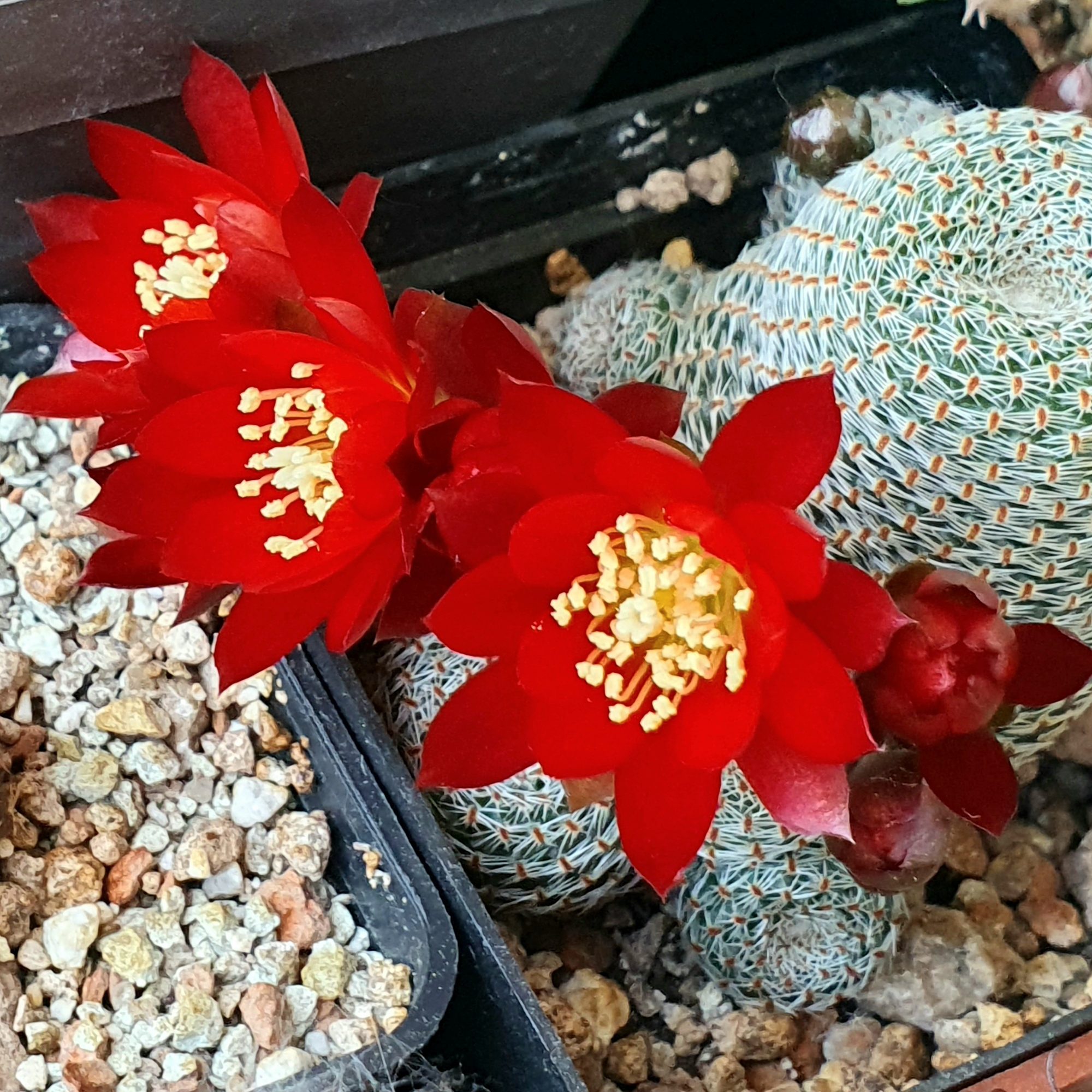
Tiny heads, each covered in short white spines laid flat like little suns, which is where heliosa comes from. It grows high in the mountains of Tarija in southern Bolivia. In spring it flowers far bigger than itself, with long-tubed blooms from the base of the heads. Most are orange; ours are bright red. The thick turnip root rots easily, so go carefully with water, and keep it dry and below 10 °C in winter.

A round, dark green Echinopsis ‘Haku-jo’ with deep ribs, each rib edged by a white felt stripe and pale spines, with a tuft of red-brown spines on top.

21 · White-edged

Haku-jo

Echinopsis ‘Haku-jo’

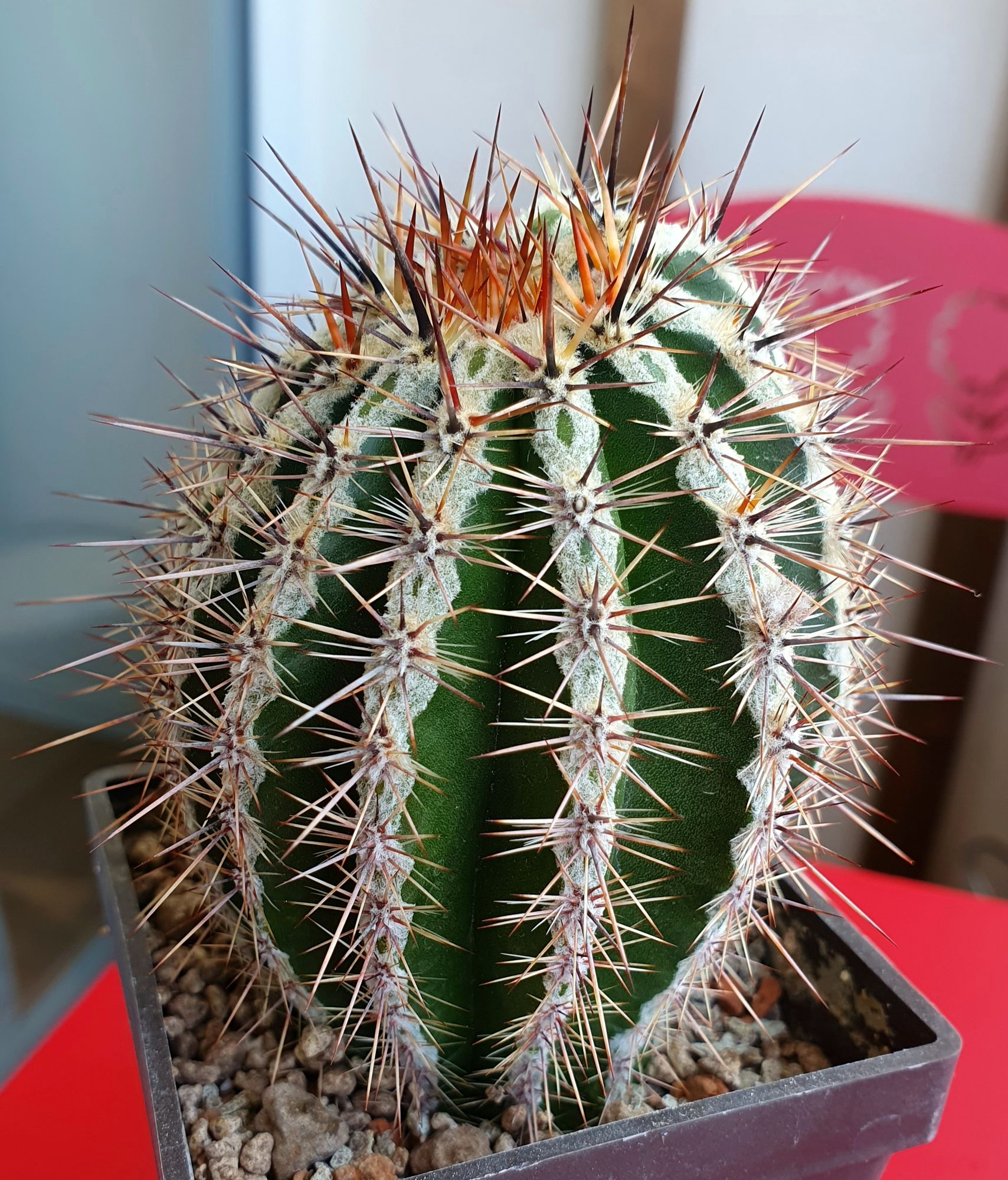
A Japanese garden form, not a wild species. Every rib carries a continuous band of white felt that joins the areoles together, so the dark green body looks outlined in chalk. Growers think the plant is a chimera, made of two layers of genetically different cells. It grows fast and easily, and in spring it opens big, scented, funnel-shaped white flowers that last about a day. Sun, plenty of water in summer, and a cool, dry rest at 10–15 °C in winter to set the buds.

Succulents
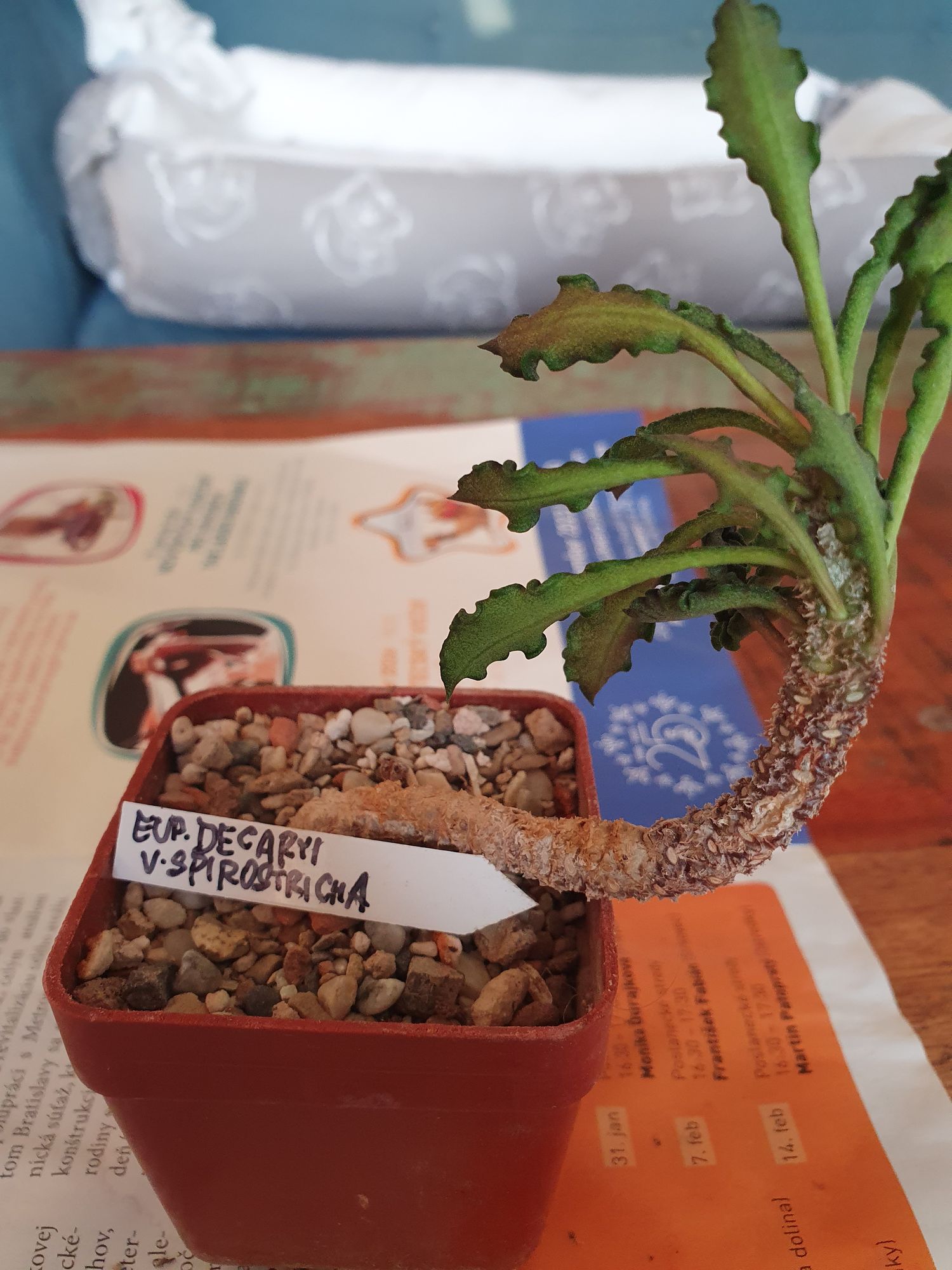
A Euphorbia decaryi with a curving stem and a rosette of wavy, crinkled green leaves, in a small red pot labelled Eup. decaryi v. spirosticha.

22 · Creeping

Decary’s spurge

Euphorbia decaryi var. spirosticha

From southern Madagascar, where it spreads in mats under spiny forest, sending runners underground. The crinkled leaves grow in a spiral, which is what spirosticha means. Unlike the cacti, it does not want a bone-dry winter: keep it warm and the soil barely moist. Mind the milky sap.

A blue-grey ribbed Euphorbia horrida seen from above, its top crowded with tiny dark red flowers on stalks with yellow pollen.

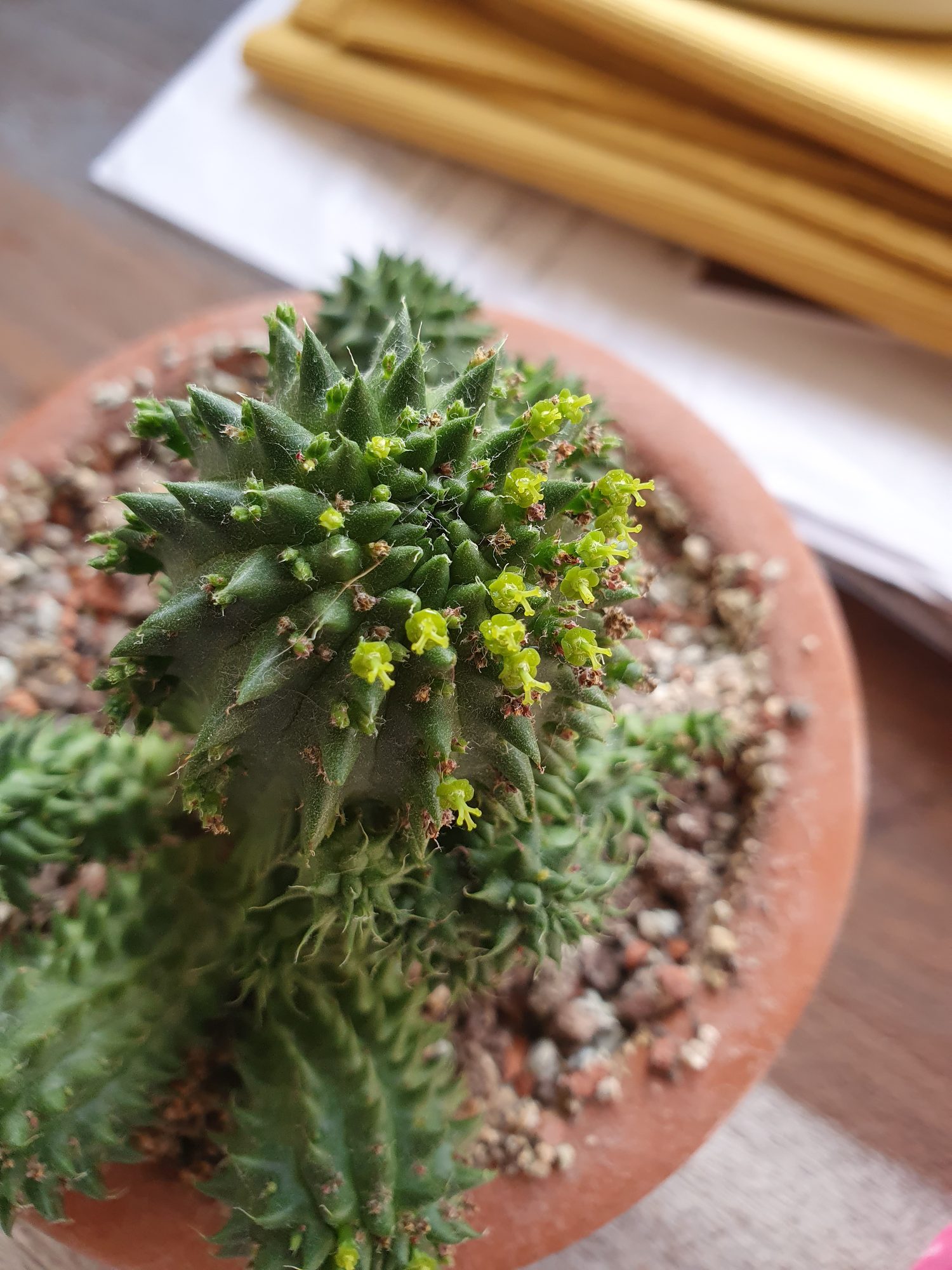
23 · Ribbed

African milk barrel

Euphorbia horrida

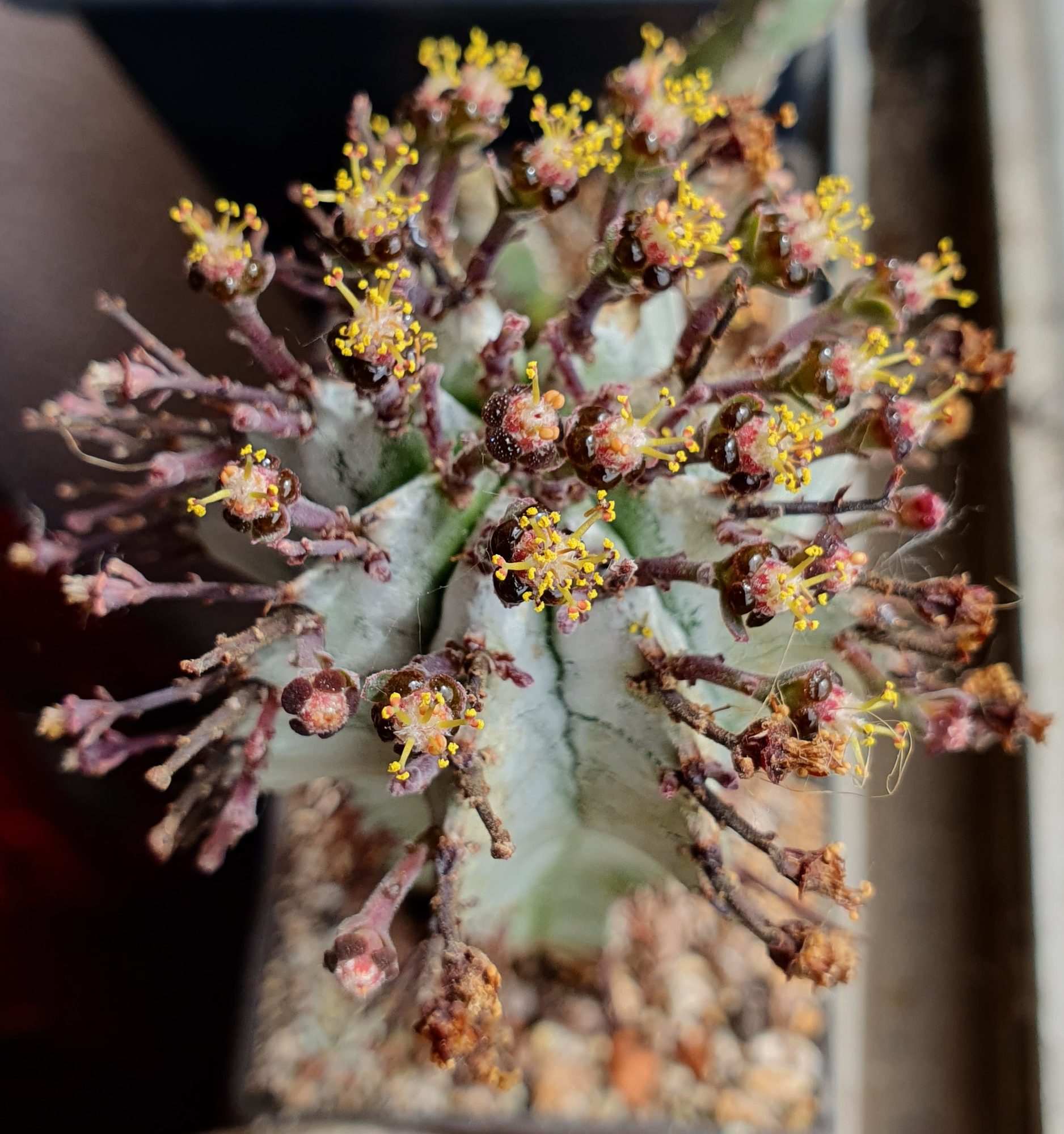
It looks like a cactus but is a spurge from the Cape of South Africa, shaped the same way by the same dry life. The deep ribs are blue-grey, and the spikes along them are old flower stalks that dried and stayed. Here it is in flower: dozens of tiny dark-red cups with yellow pollen. Lots of sun, a dry winter around 12 °C, and gloves, because the milky sap burns.

A clump of Euphorbia pseudoglobosa: stacked green balls covered in knobs with pinkish tips, in gravel.

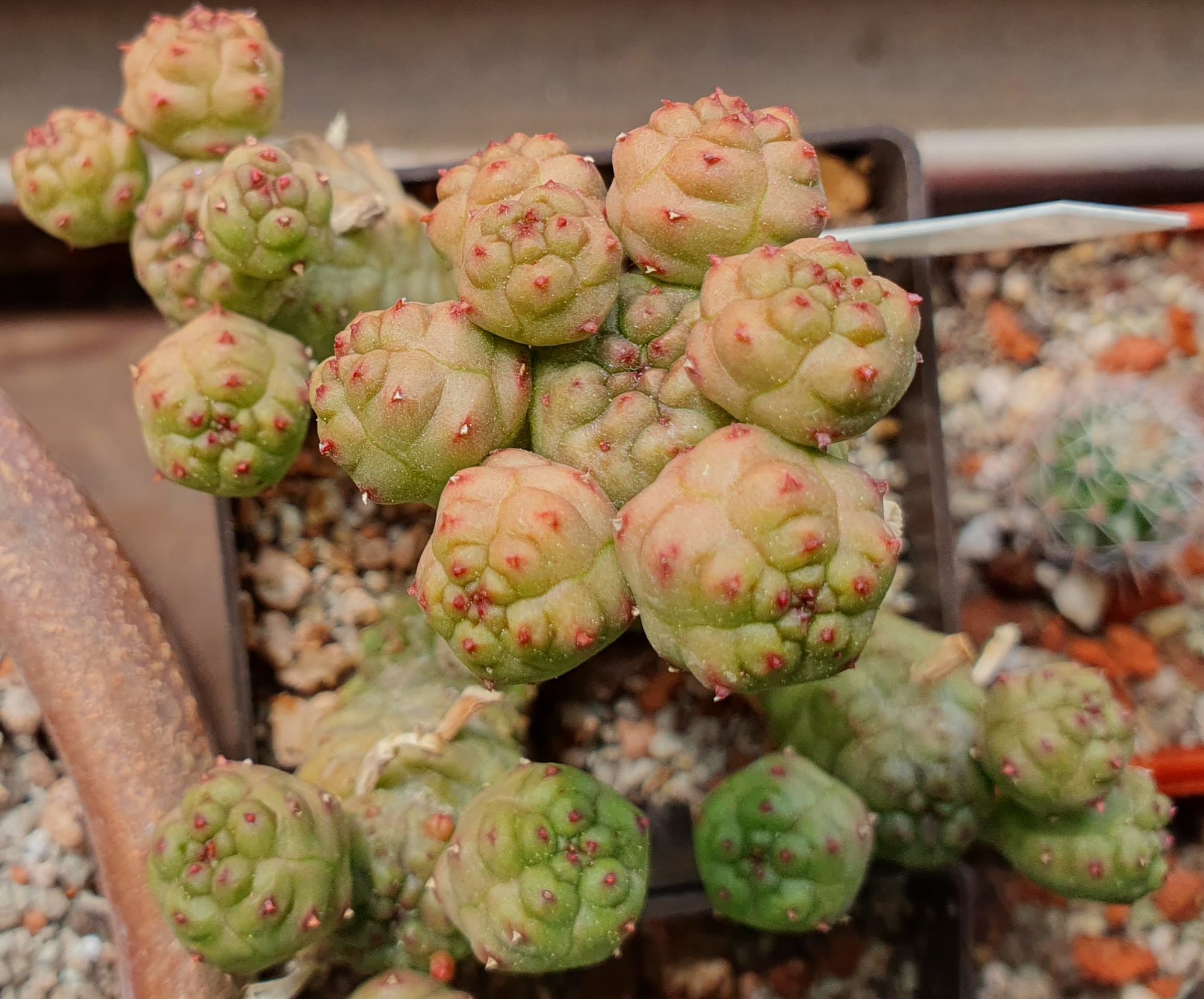
24 · Stacked

False globe spurge

Euphorbia pseudoglobosa

A pile of green balls, each one knobbly and tipped with pink, stacked into chains as the plant grows. No spines. It comes from the Eastern Cape in South Africa and looks so much like Euphorbia globosa that it was named after it: the “false globosa”. Under the clump is a big taproot, so it needs a deeper pot than it seems to. Water sparingly, and only when the soil is dry. Mind the sap.

A green Euphorbia susannae covered in soft fleshy tubercles, small yellow-green flowers at its tip, with offsets around the base in a terracotta pot.

25 · Knobbly

Susanna’s spurge

Euphorbia susannae

Soft green stems covered in fleshy, pointed knobs that look prickly but are not. It comes from the Little Karoo in South Africa, where it often grows half buried. Little yellow-green flowers crowd the tips in autumn, sometimes again in spring, and new heads keep popping up around the base until it becomes a wide clump. It was named after Susanna Marloth, wife of a Cape botanist. Bright light, gritty soil, and a drier rest in winter.

A low clump of Haworthia cooperi with plump, glassy green leaves, their tips like little windows, growing in pink and white gravel.

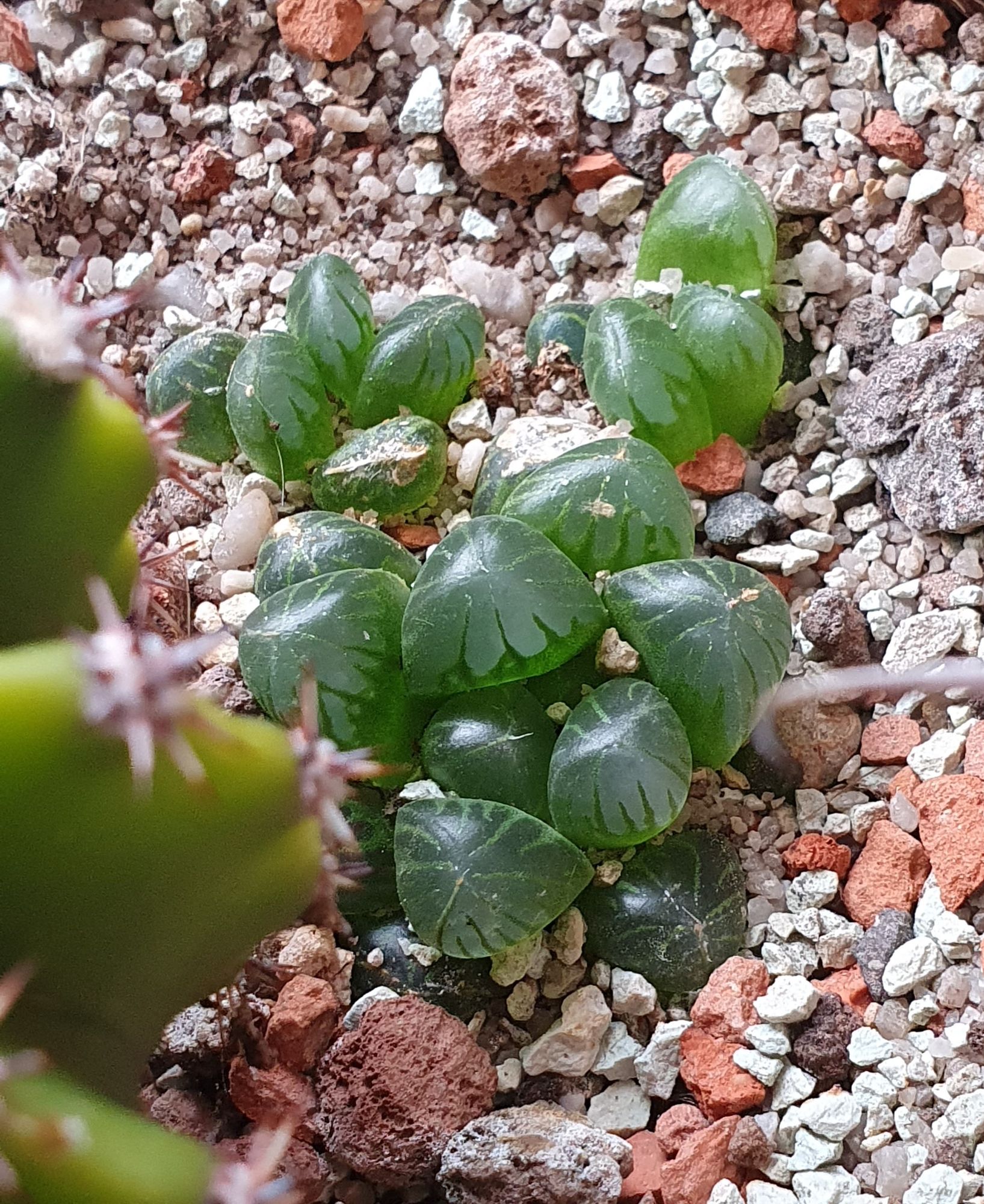
26 · Windowed

Window haworthia

Haworthia cooperi

From South Africa’s Eastern Cape, where it lives half buried, often under shrubs, with only the leaf tips showing. Those tips are clear windows that let light down into the leaf. It likes bright shade more than full sun, and water only once the soil has dried. Ours sits in the gravel among the cacti.

A Gasteria batesiana rosette of narrow, triangular leaves covered in rough white dots and bands, flushed pink and green, in a black pot.

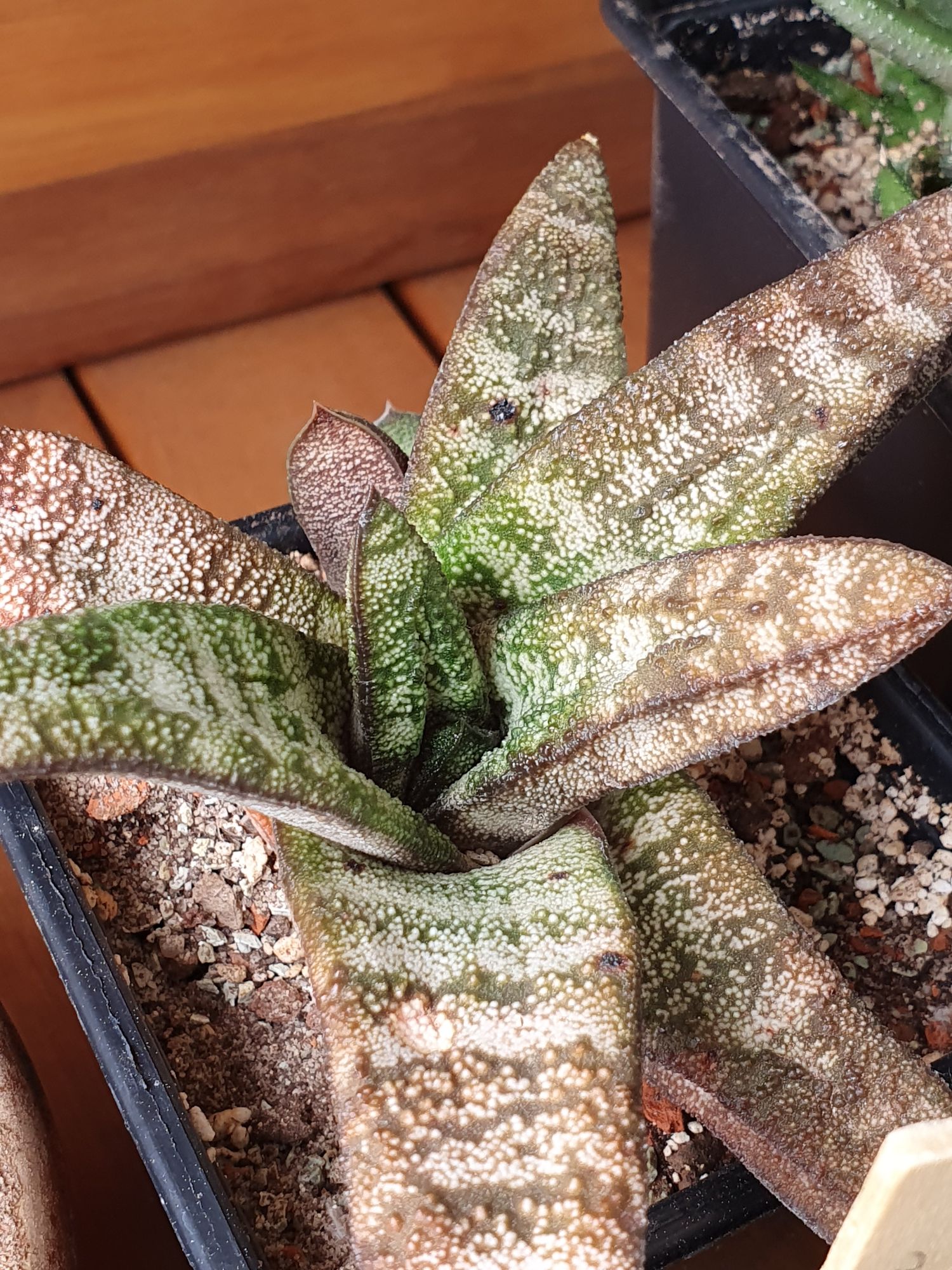
27 · Rough-leaved

Rough gasteria

Gasteria batesiana

A gasteria from shady rocky places in the north-east of South Africa. The narrow, triangular leaves feel like sandpaper, covered in tiny raised white dots that run together into bands. In good light they flush pink and copper, as ours do. The flowers are small, curved and pinkish, hung along a long stem; their swollen base gave the genus its name, from the Greek for belly. Bright light without hard sun, and water when the soil is dry.

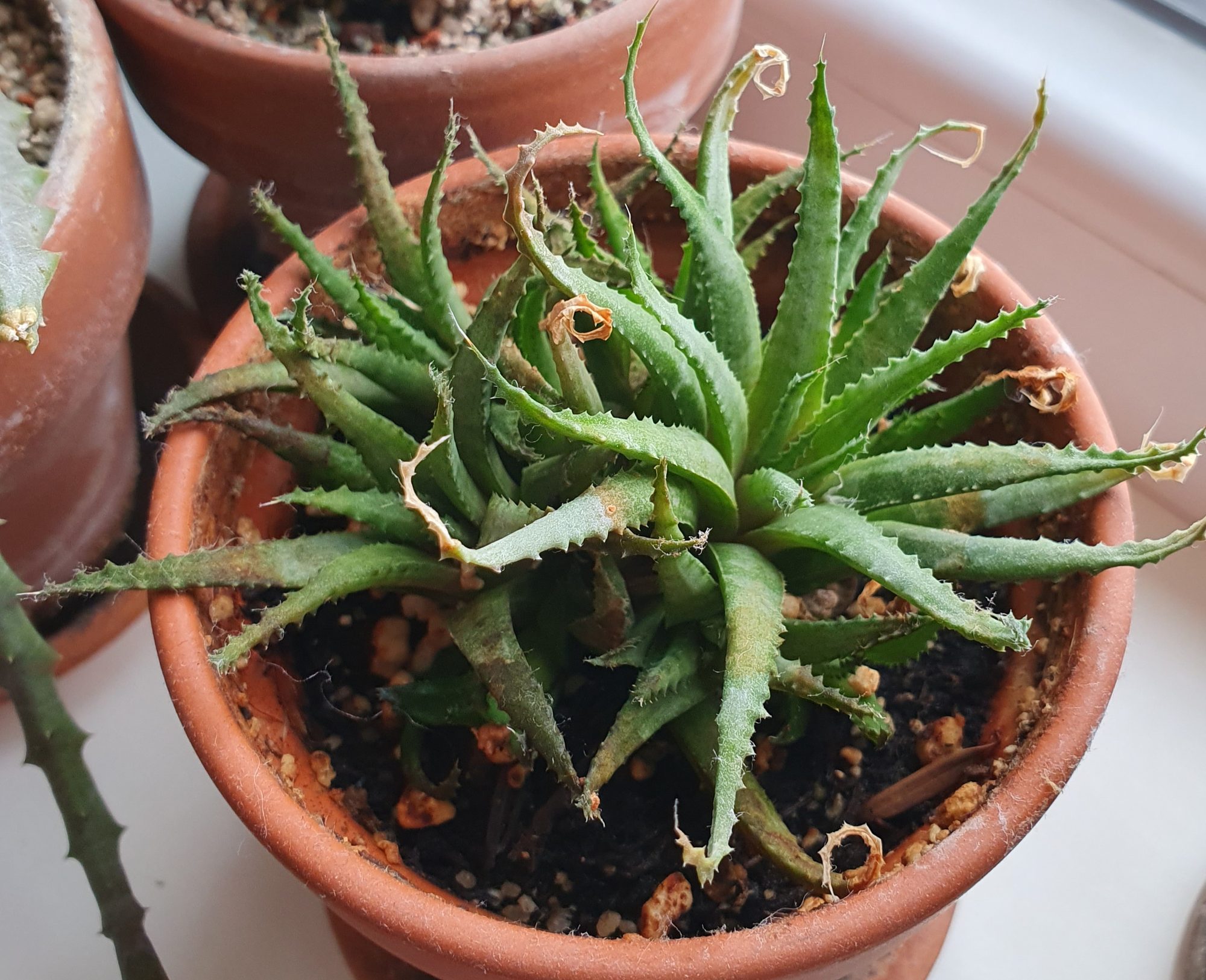
A clump of narrow, tapering grey-green Haworthia leaves with fine pale teeth on the edges and a few dry curled tips, in a terracotta pot.

28 · Toothed

Blue-grey haworthia

Haworthia chloracantha var. subglauca

Often sold simply as Haworthia subglauca. Its home is tiny: granite outcrops around Great Brak River near Mossel Bay, on the south coast of South Africa. Subglauca means almost blue-grey, from the waxy bloom on the leaves, which sets it apart from the plain green forms of the species. The narrow, upright leaves taper to a point and carry small pale teeth along the edges, and it offsets freely into a tight clump. Bright light without harsh midday sun, a gritty mix, and water once the pot has dried.

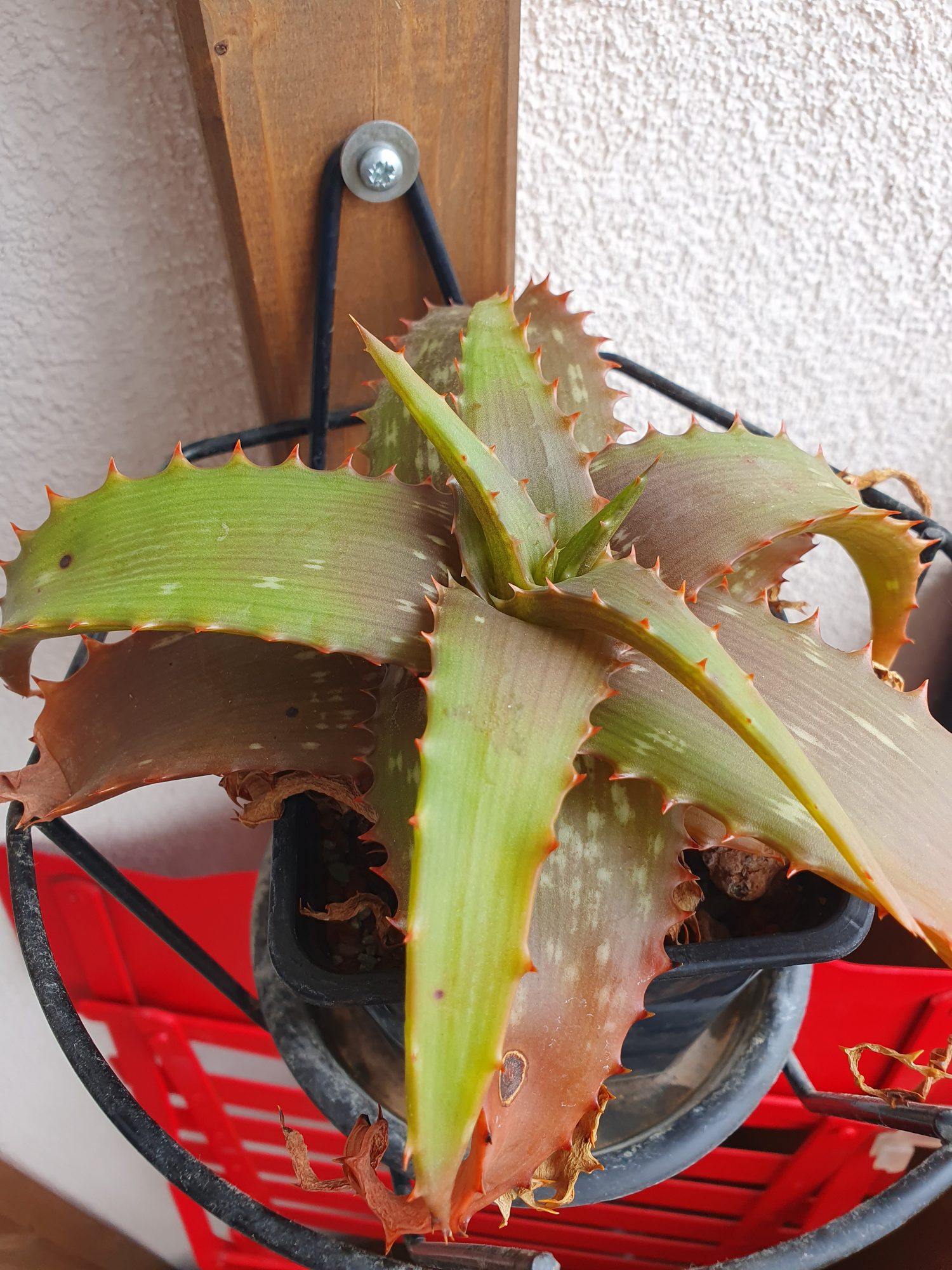
An Aloe petrophila rosette of thick triangular leaves with toothed edges and pale streaks, flushed red-bronze at the tips, in a hanging pot on a balcony.

29 · Cliff-dwelling

Rock aloe

Aloe petrophila

Petrophila means rock-loving. In the wild it grows only in cracks and on ledges of cliff faces in the Soutpansberg mountains of Limpopo, South Africa, and nowhere else. Thick triangular leaves with brown teeth and pale streaks make a loose rosette; in strong sun they blush red-bronze, as ours does on the balcony. Coral-pink flowers can come in late autumn and winter. A sharp, fast-draining mix and a bright, frost-free winter.

When they flower.

One row for each plant, one column for each month. The pale band is when the plant usually flowers, from growers’ notes. A bright dot is a month we photographed it in flower ourselves. Pick a month to see who is due.

Where they come from.

Every plant here grew wild somewhere first. Most of the cacti come from the deserts of northern Mexico and the fog coast of Chile; the succulents from South Africa and Madagascar. Each dot is where a plant’s wild relatives live. Tap one to see who.

The Americas
Southern Africa and Madagascar

Seedlings.

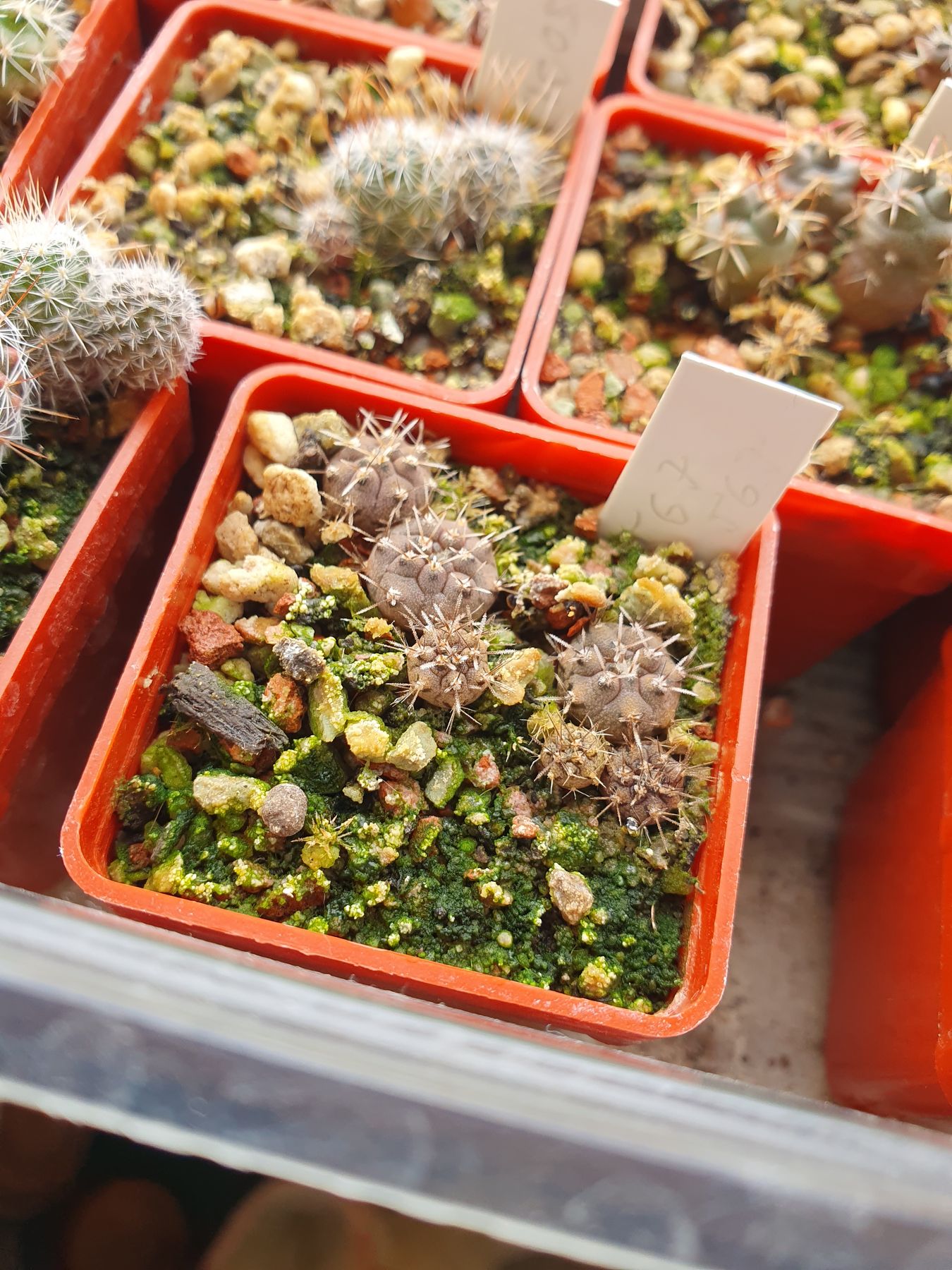
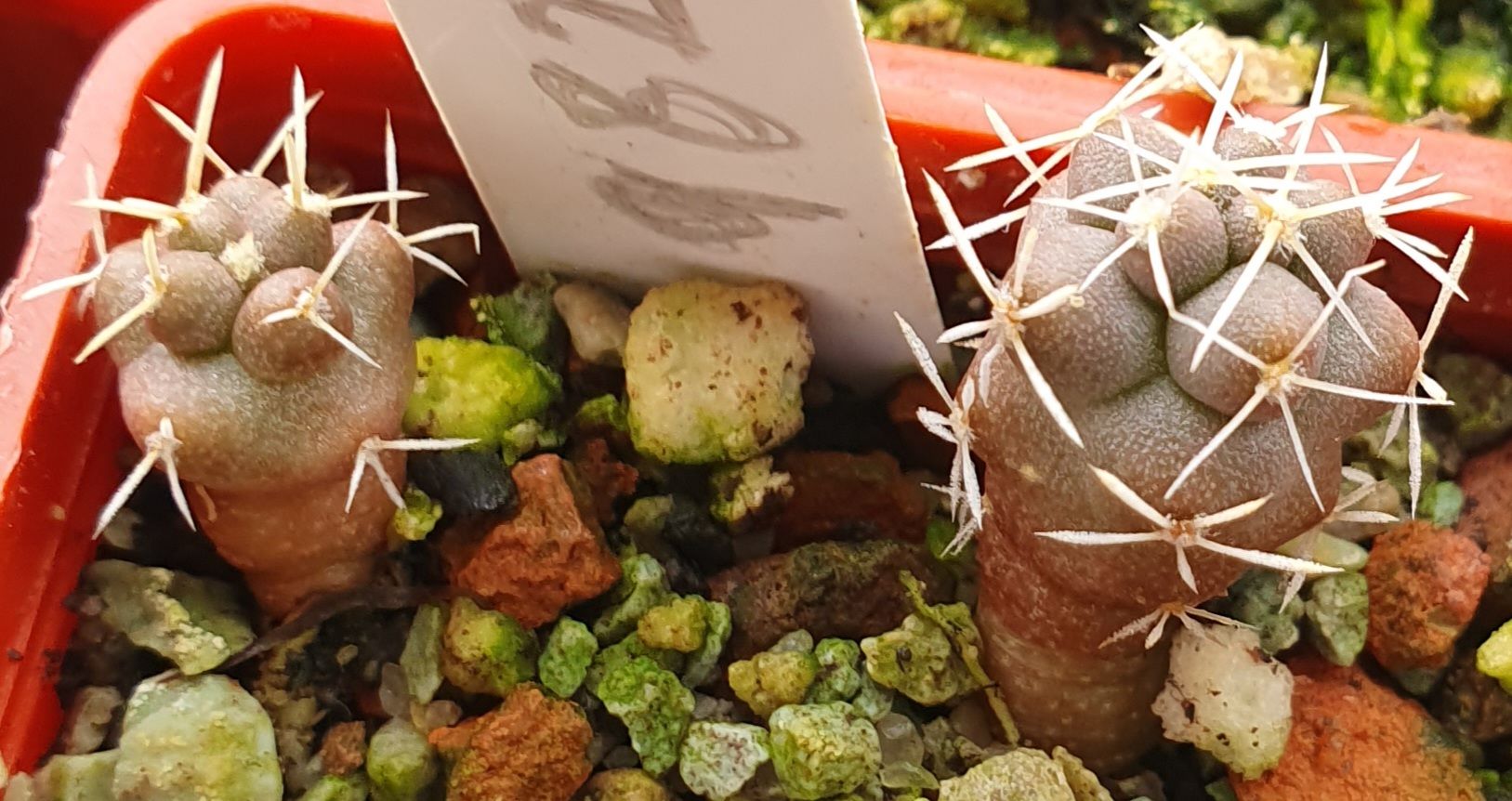
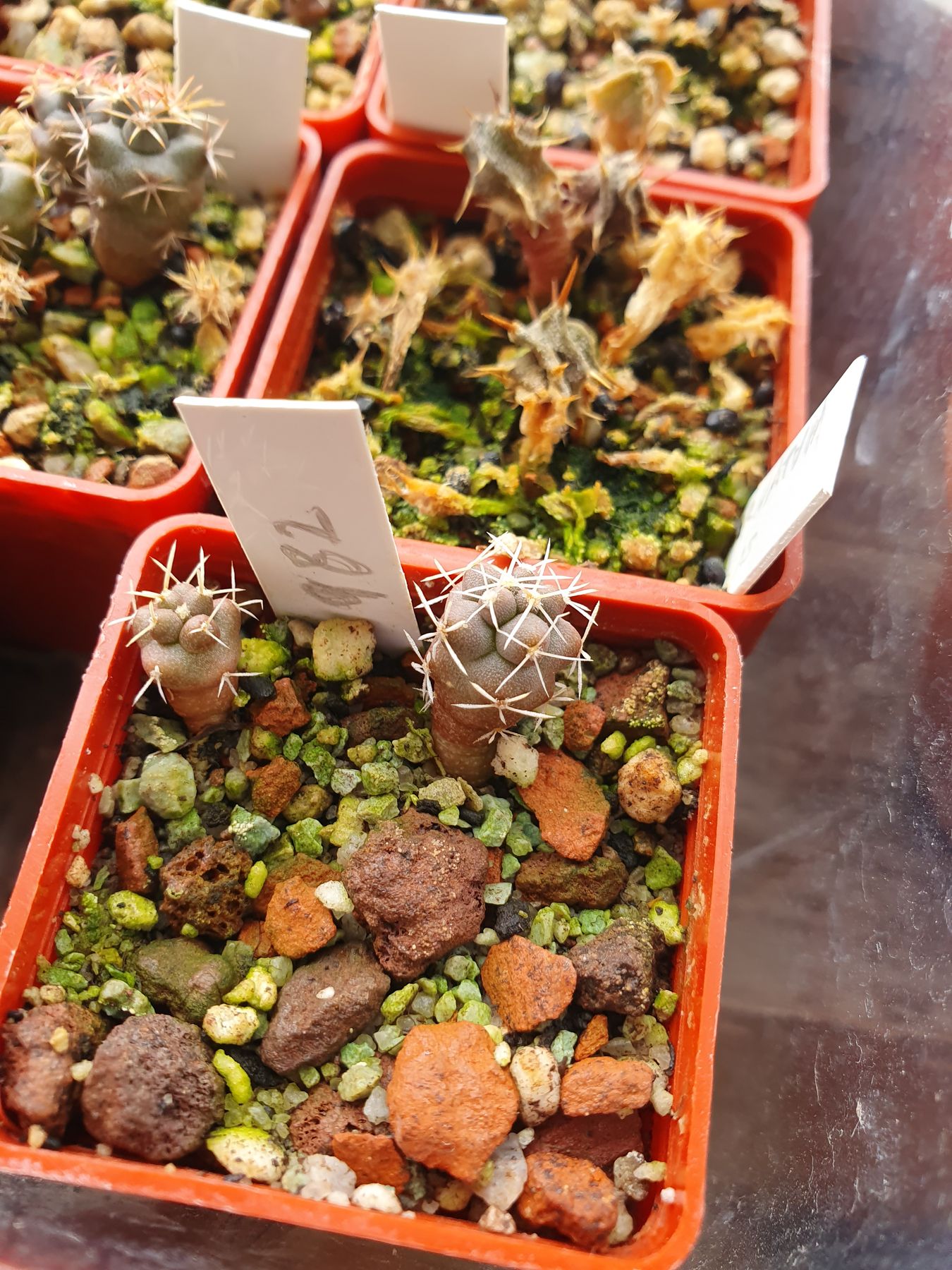
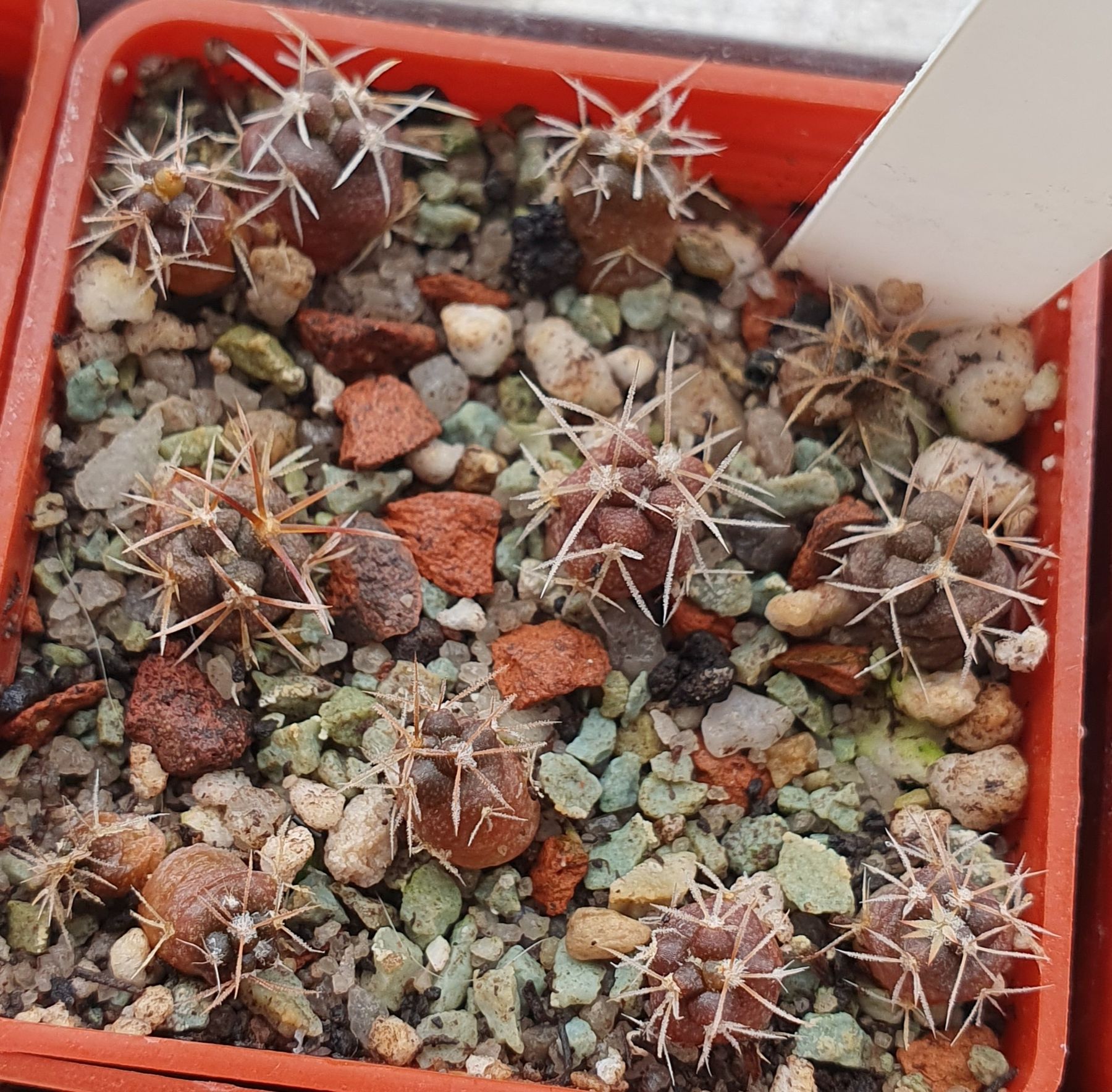
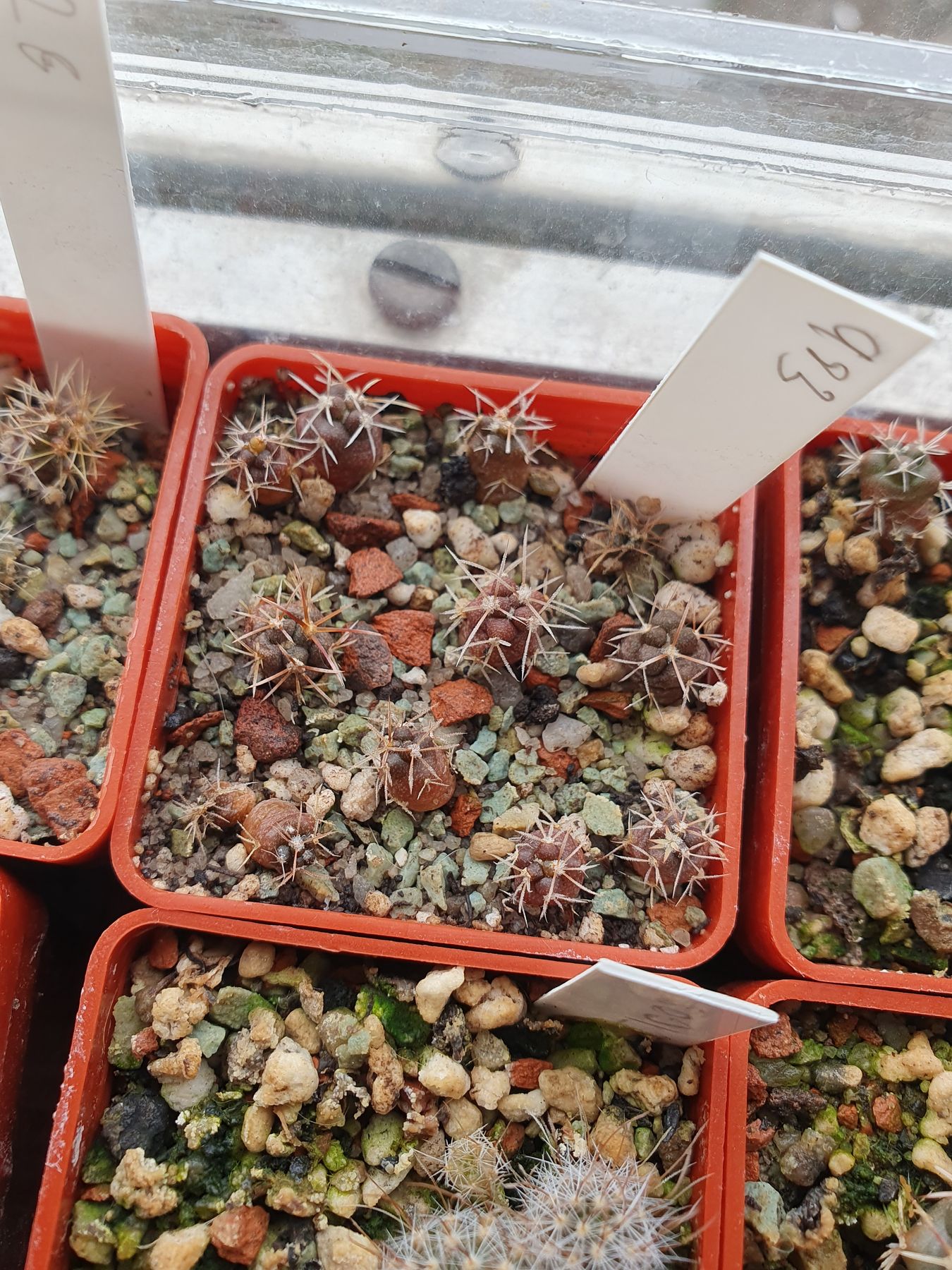
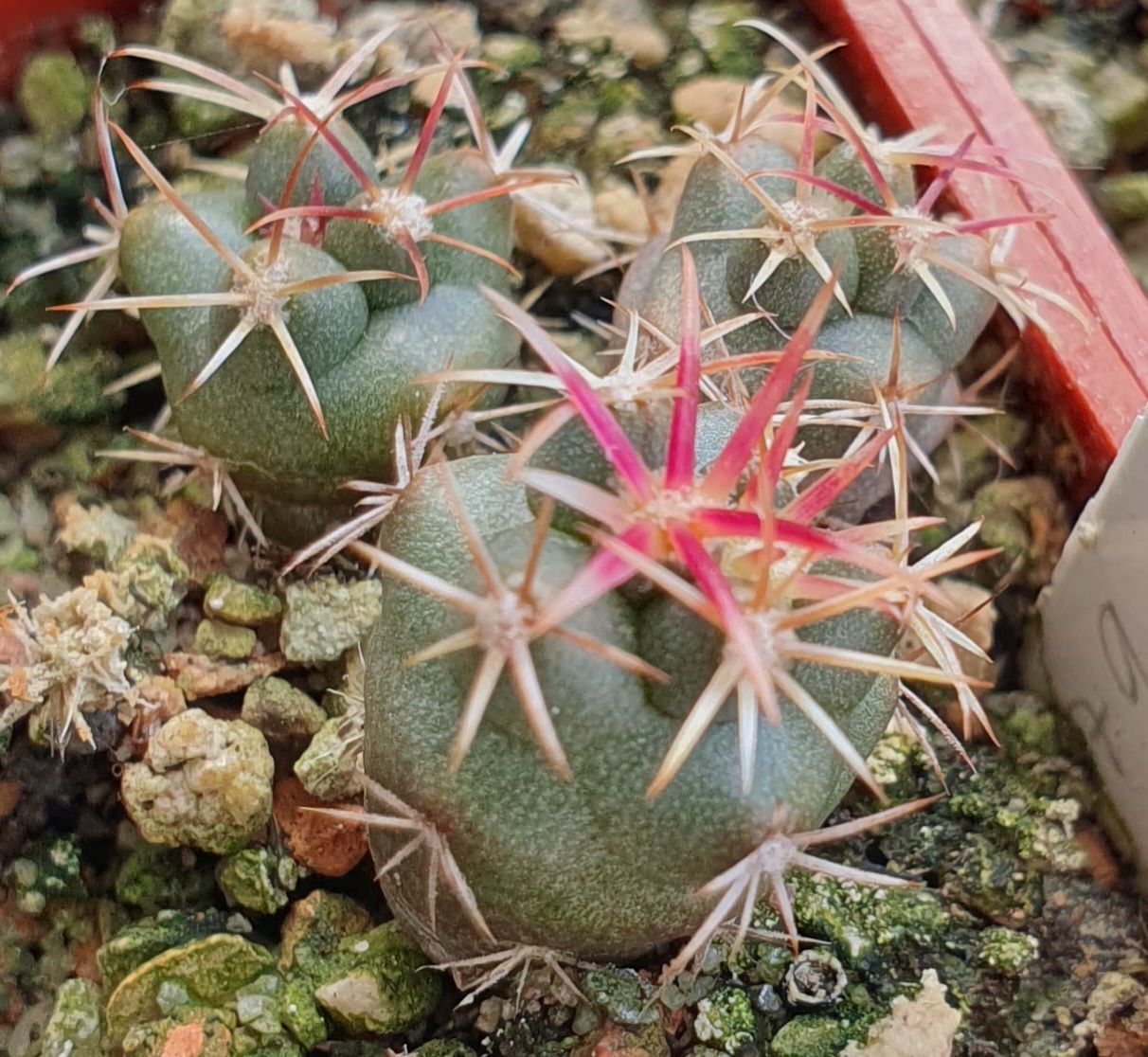
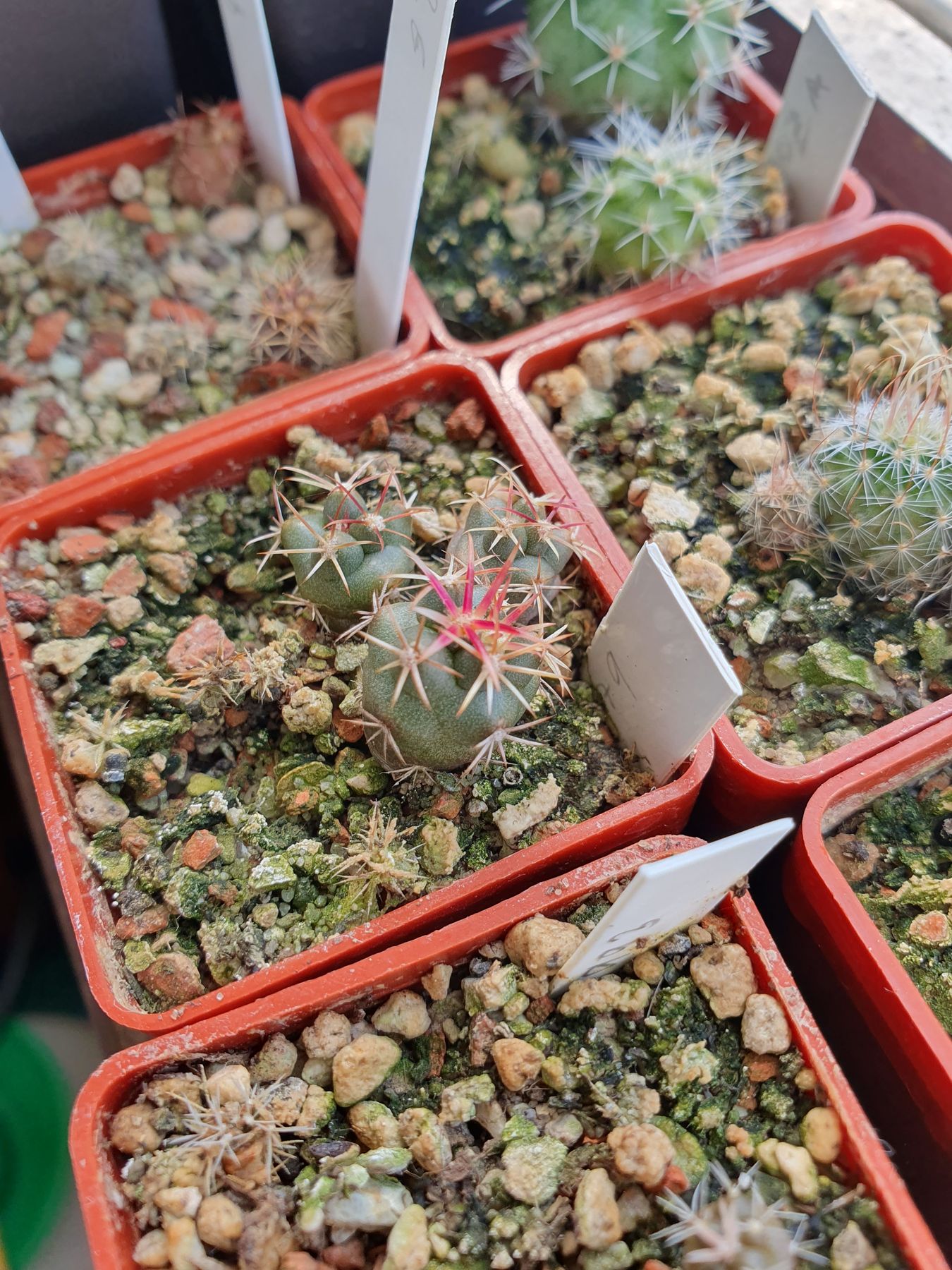
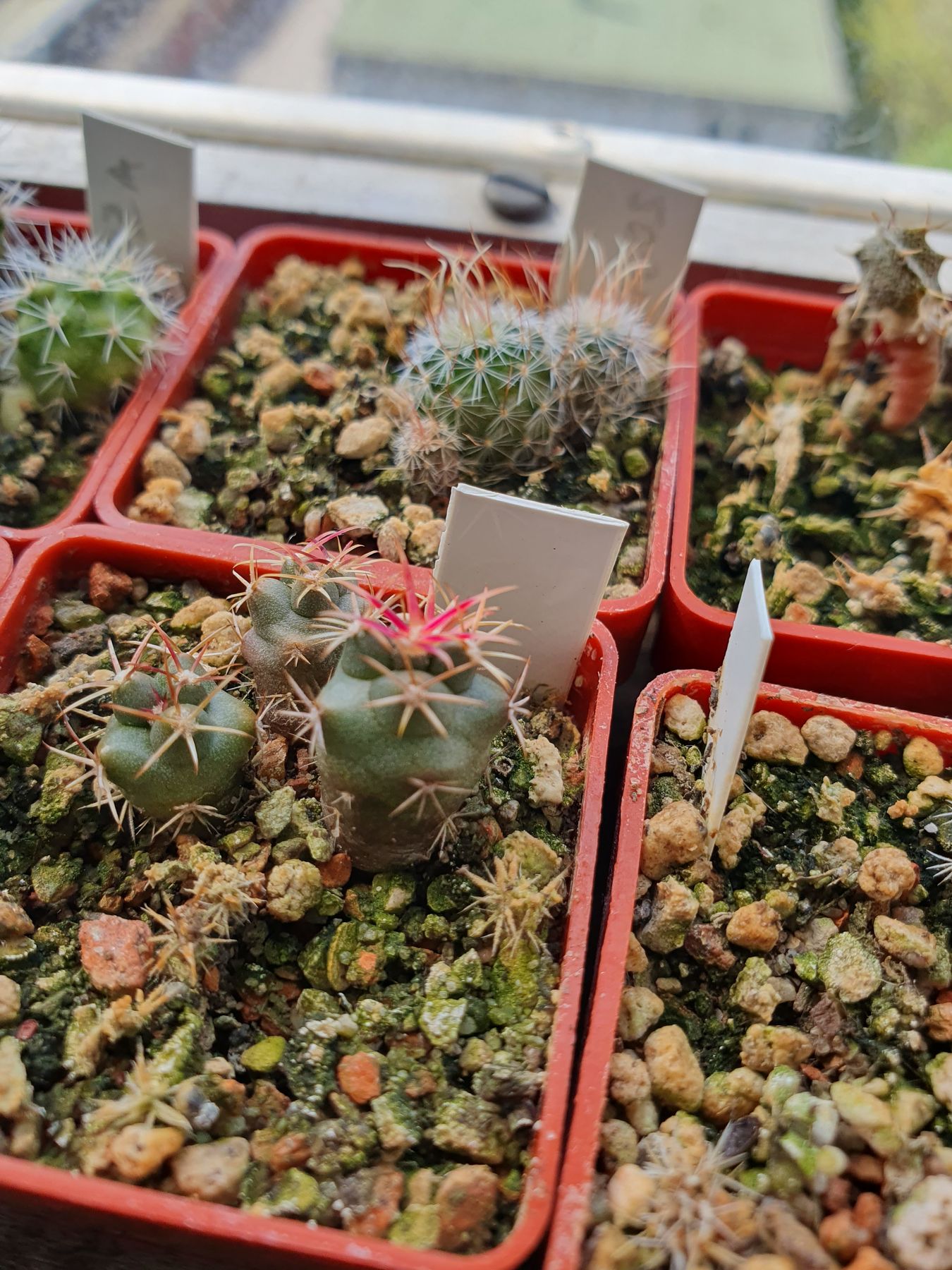
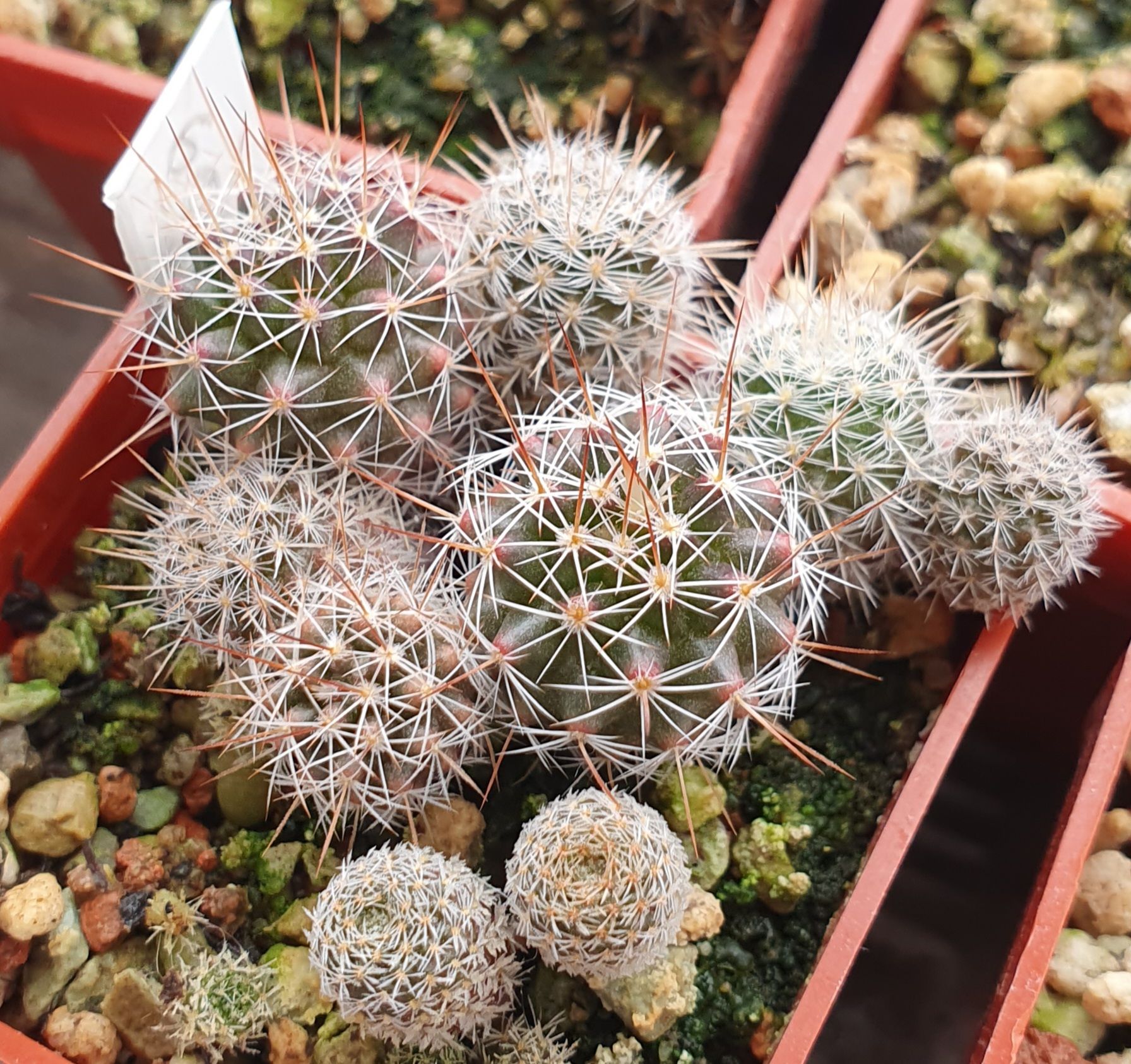
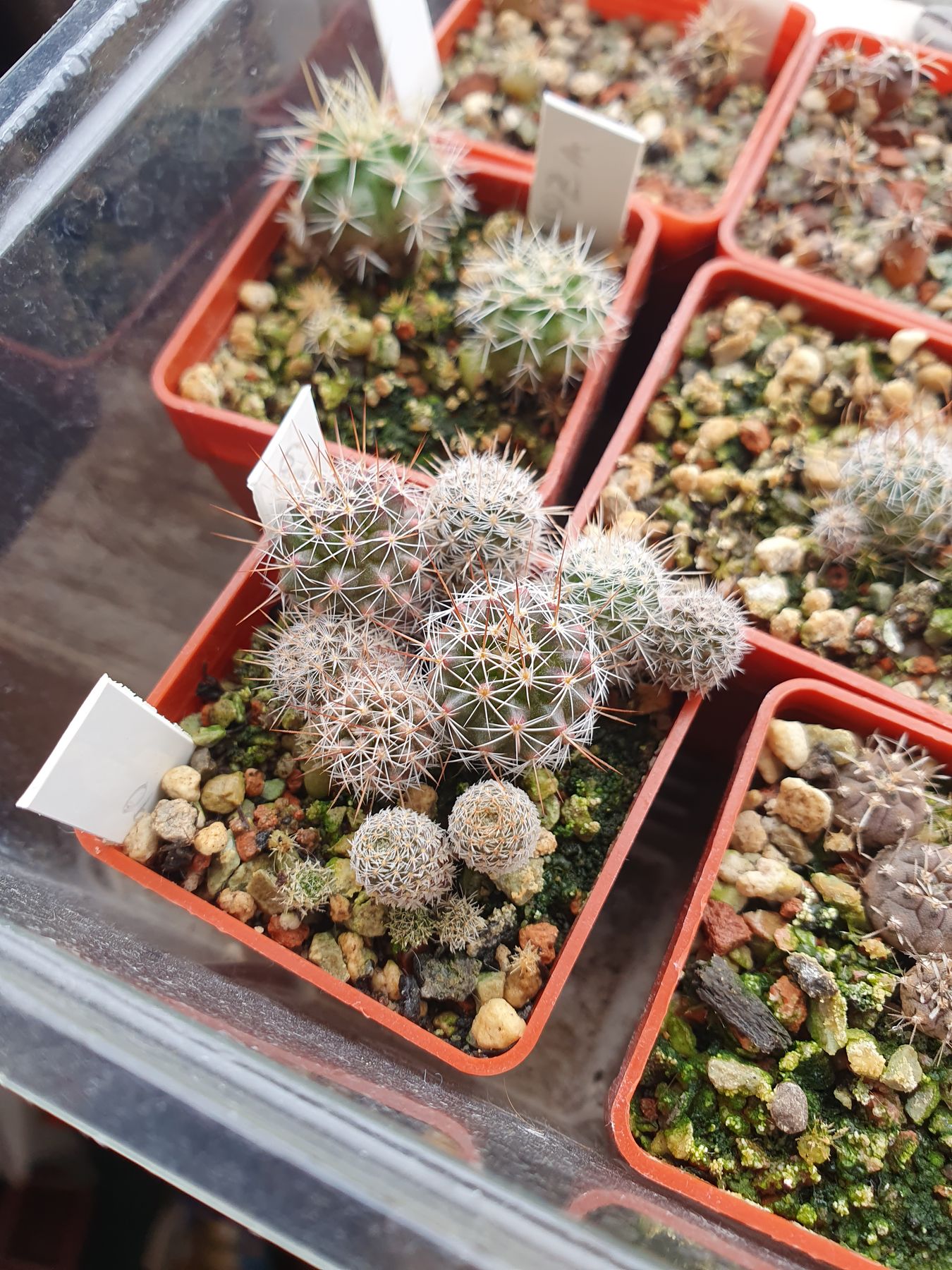
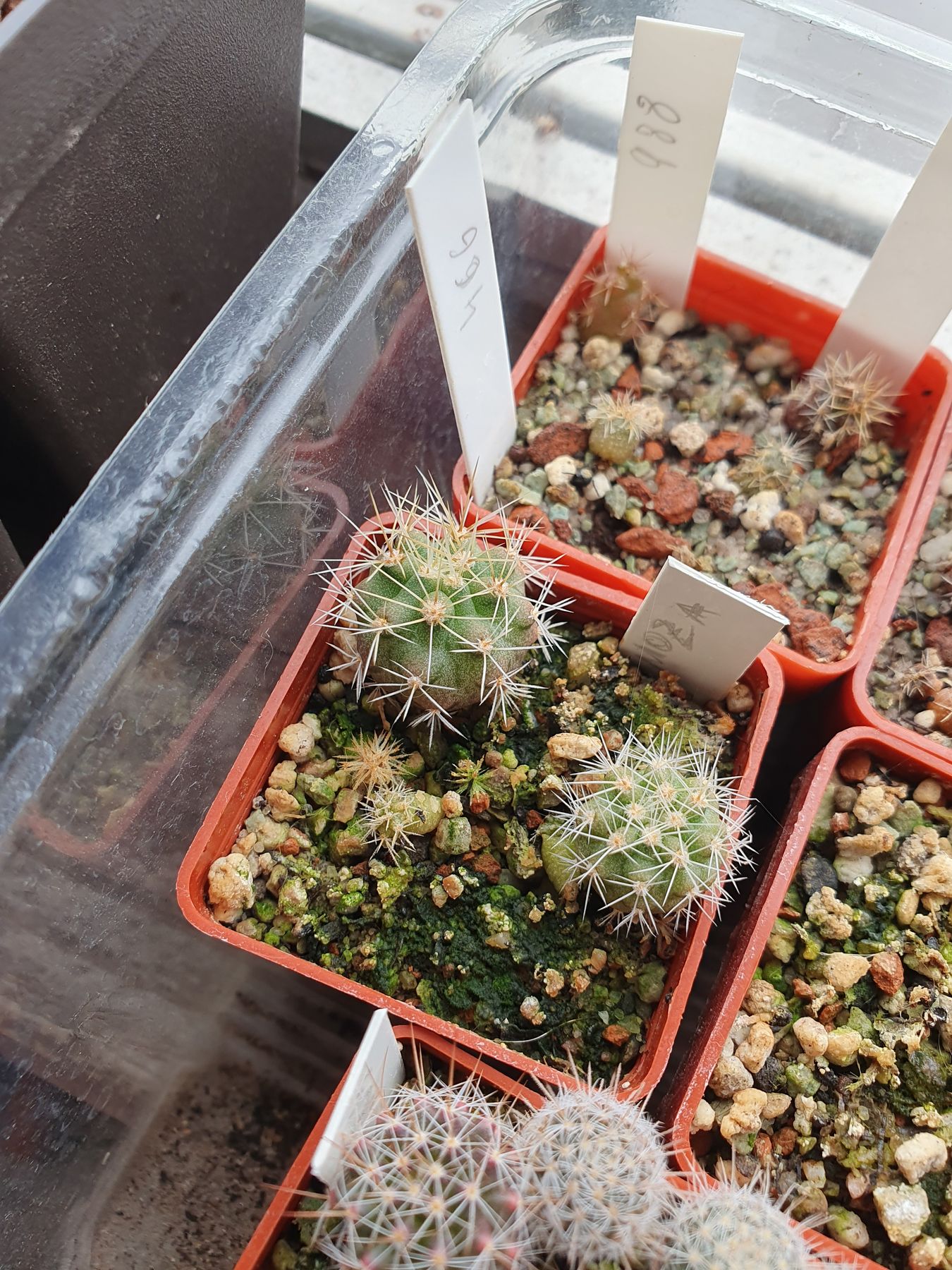
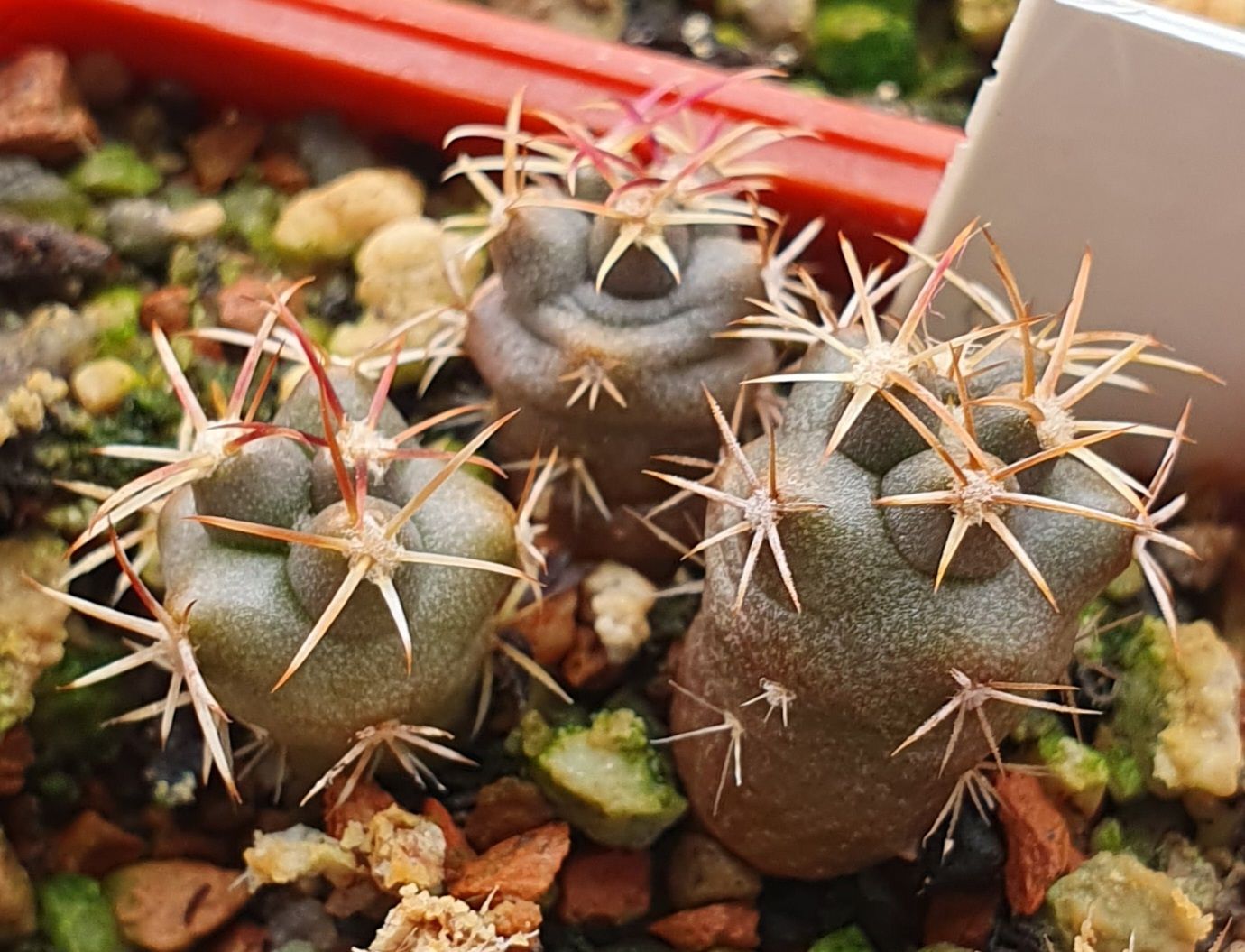
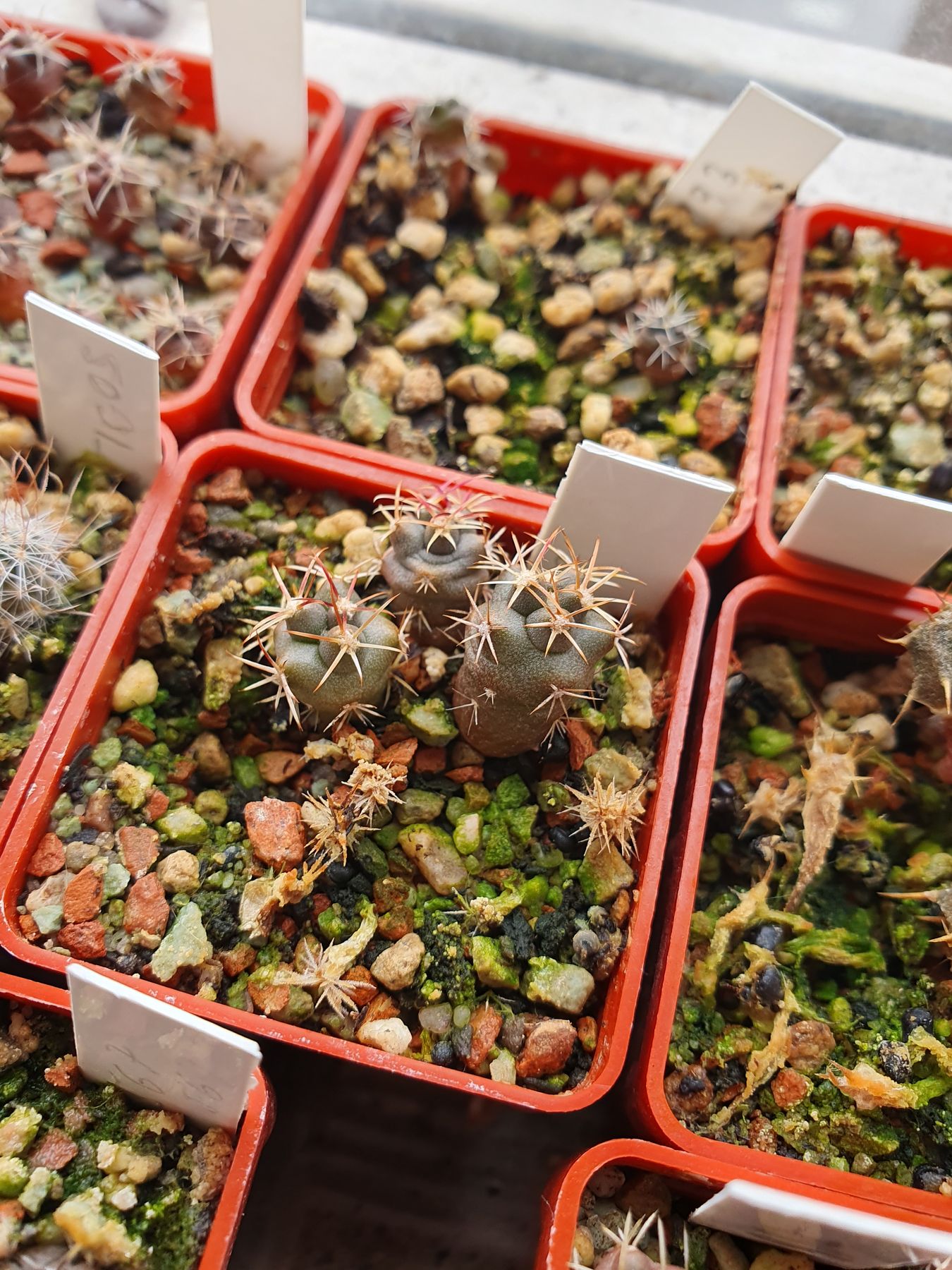
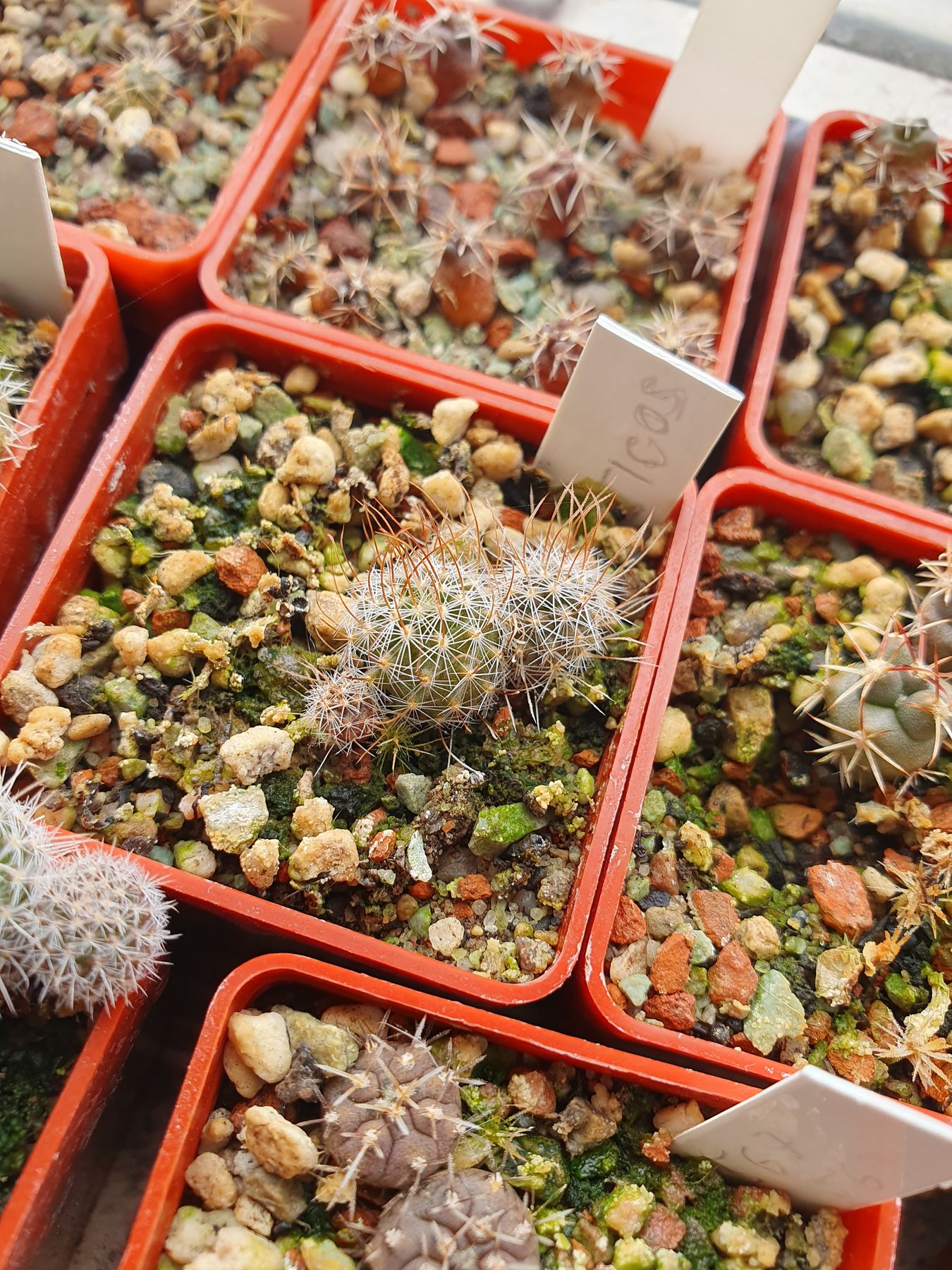
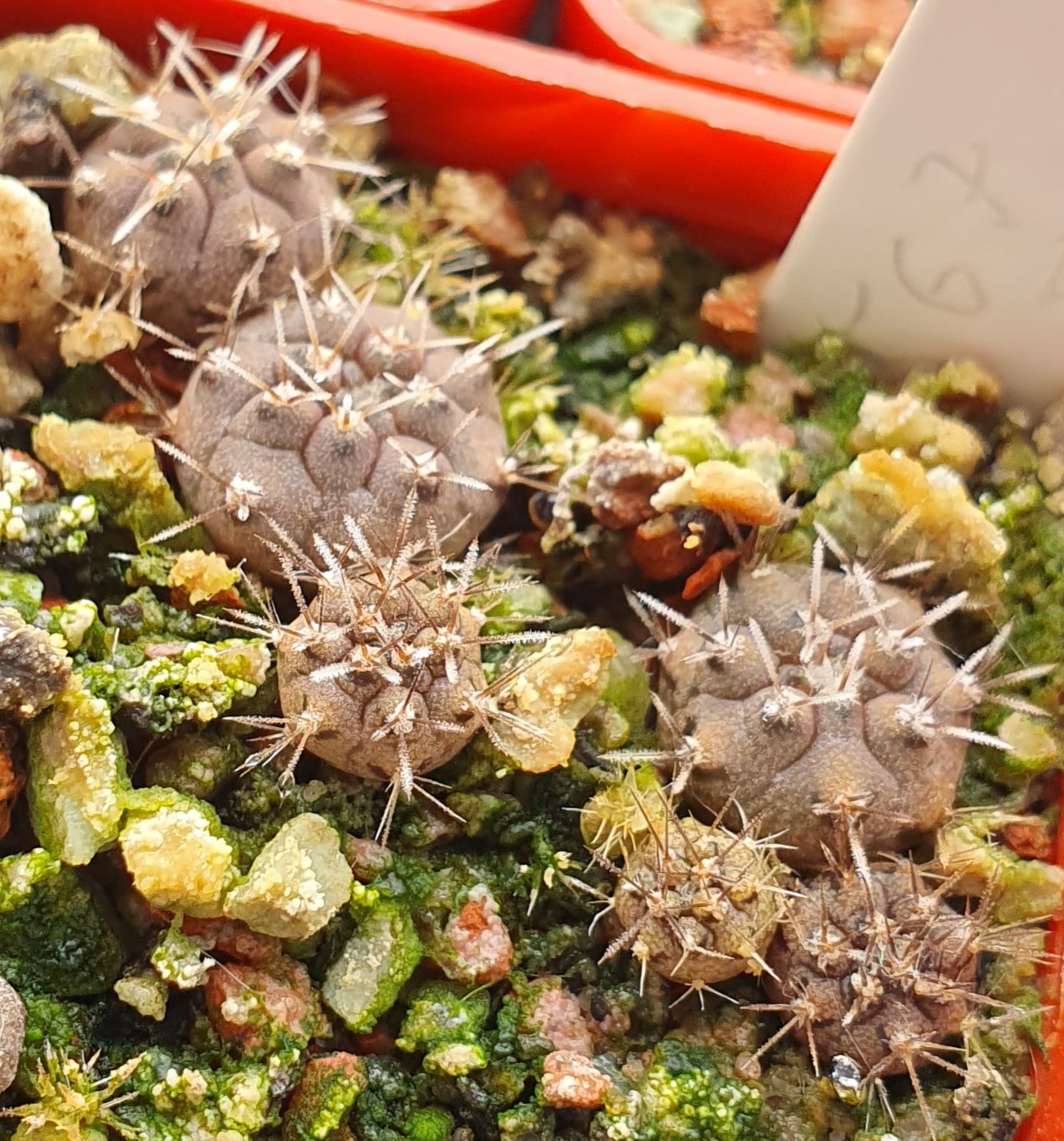
The young ones, in their red pots under the lid of the tray. They have numbered labels but no names here yet: at this size many of them look alike. Each will move up into the collection once it is big enough to tell for certain.

17 photographs · spring 2024

How they are kept.

Light

A bright window. Turn each pot a little every month so the plant does not lean itself into the glass. The haworthias are happier just out of direct sun; the aloe takes the full balcony sun.

Water

Soak the mix, then wait until it is dry. In winter the cacti get none at all. The feather cactus gets less than the others, and Decary’s spurge is the exception: a little water all year. The Turk’s cap is the one that must stay warm in winter.

Soil

Mostly grit, in a pot with a hole. Never leave one standing in a saucer of water. The plants with thick taproots get deeper pots.

The keeper.

A collection kept near the glass, on the windowsill and the balcony shelves. Each plant here is one we can name for certain, from its label or from a shape you cannot mistake. The rest will join as they are identified.

These pages are the record. Every photograph is of our own plants.

That’s all 29. The room can rest now.